
My Park Pass
I was a little worried that I would be disappointed when I went to Siem Reap to explore the various temples in Angkor Archeological Park, because I had such high expectations at the very least for Angkor Wat, not to mention the other temples. But it completely lived up to expectations! It really is as spectacular as all the hype about it, amazingly enough. Get ready for a lot of pictures, because even though I pruned what I decided to post, it was impossible to prune enough!
I had left Ho Chi Minh City for two nights in Phnom Penh, where I took the cooking class I wrote about earlier and met another American who was traveling to Siem Reap as well. We decided to share a guide and driver for our first day in Siem Reap, when we visited much of what is called the “little tour”, encompassing Angkor Wat, Angkor Thom (including Bayon), Ta Prohm, and a couple of other shorter stops. Exhausting but fabulous!
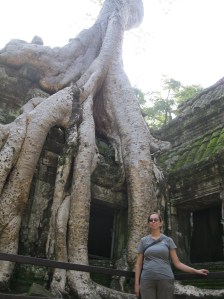
Me at Ta Prohm temple
We started out the day with Ta Prohm, the temple featured in all the postcards of banyan trees growing into or on the temple, and also known for its cameo in the Tomb Raider movie. Seeing the trees was amazing. Given how big they are, they must be incredibly old. Here and there, they are pushing the temple stones away, but in other places, it looks like they are supporting the temple. Ta Prohm also has some lovely carvings. Something you see throughout the various Angkor period temples (and on some of the earlier temples) is figures of dancers, called apsara. I was told the various poses of the dance reflect the steps of planting, growing and harvesting rice.

Approaching Ta Prohm

First lovely carvings of the day!

Tree and carvings

Another magnificent Ta Prohm tree

A further view

Ta Prohm ruins

Ta Prohm lintel

Greenery at Ta Prohm

Snake-like tree roots

More glorious carvings

Another Ta Prohm tree

Ta Prohm

Ta Prohm

An apsara peaking out from behind some roots

The Tomb Raider money shot

Me and the tree shown in the movie

Ta Prohm

Ta Prohm carving

Very Indiana Jones-like!

Ta Prohm tree

A Buddha in part of the ruins

By the exit

Leaving Ta Prohm

First monumental stone face of the day – Ta Prohm?
We headed towards Ta Keo, but unfortunately they were working on maintenance/restoration and had closed it off for the day. I was ok with skipping one set of super-steep stairs as I suspected there were many more to come!

Ta Keo
Next we entered the Angkor-era royal city of Angkor Thom. Angkor Thom’s walls are well worth seeing, as the various gates consist of monumental stone heads representing the king or a god, and there are several terraces as well. Then within the walls lie a number of temples and royal buildings, the best known of which is Bayon. (Yes, that would be the monumental head temple – forty or fifty of them, I’ve heard.)
We entered through a victory gate:

Victory or the king

Victory gate, Angkor Thom

Gods or demons from the churning of the Sea of Milk story

Me at Angkor Thom

Organic-looking stone columns represent elephant trunks
and continued on to Bayon. Bayon is a bit of a contrast, because not only does it have monumental sculpture at the top of the temple, but it is surrounded by some of the finest carvings from the period.

Bayon

Apsara carving

Outlying massive head

More than 90 degrees on the steps up to the library

Bayon – the top

Bayon

Bayon detail

Group of heads up top Bayon

Group of heads up top Bayon

Elfin Apsara

Bayon’s surroundings

Bayon apsara

Another Bayon apsara

Bayon
These carvings show scenes of going to and coming from battle:
But the morning wasn’t over yet! The next temple to explore was Baphuon. Climbing it was…interesting, for someone scared of heights. (The stairs are awfully steep!) There aren’t really major carvings with this temple, but a great view from the top.

Approaching Baphuon

It’s a bit of a climb…

Baphuon carving

View of the causeway to the temple

Doing ok with the heights so far…

Monks coming to visit Baphuon

More stairs…not great for those who fear heights but I made it!

A corridor on top of Baphuon

The view from the top

On top of Baphuon
Interestingly, the back of the temple itself forms a “statue” of a giant reclining Buddha. Can you see the curve of its face on the left?
We passed the ancient seat of the king, the only part of the palace to be built in stone, apparently. All of the other non-religious royal buildings were built of wood and no longer exist. I passed on climbing up this one.
We headed out of Angkor Thom through another gate and onto the Elephant Terrace, where the king apparently watched elephant fights eight hundred years ago. At this point it was time for lunch, before heading to spend much of the afternoon at Angkor Wat. We ate at one of the touristy restaurants across from Angkor Wat, nothing too great, but not bad Khmer food. Fresh coconut juice drunk directly from the coconut helped to fortify us for the afternoon – when people mention how hot Siem Reap is, they aren’t kidding! Very, very hot and humid.


 trails untrod