
Vietnam Friendship Monument
Strange though this will no doubt sound, Phnom Penh for me was in large part cafe hopping. Not that I didn’t go see most of the tourist sites, but I was nursing a pretty bad head cold during most of my stay here and didn’t push myself to do much more than ingest lots and lots of fluids.
While Laos is very poor – I think poorer than Cambodia – it’s actually been Phnom Penh that hit me in the face with the poverty in Southeast Asia. So many people are so very thin. And whole families essentially live on the streets of the city, sleeping at night on a woven mat unrolled on the sidewalk or in a city square. The streets smell. Yet with all this, Phnom Penh still has more character than Vientiane.
Phnom Penh is a city flooded with expats, many of them associated with an NGO of some sort. Chatting with the employees at my hotel, I found a disturbing sense that, to them, to be foreign (or at least Western) is to be better, richer, smarter, more likely to solve Cambodia’s problems. And therein lies the rub for all worthy development causes. How do you make sure you are creating sustainable development? How do you prevent creating a client state dependent on foreign aid and initiative? Most of the NGOs I interacted with were Western, even if they had local partners or trained local at-risk populations. I’m certainly not saying that these aren’t worthy causes. I definitely felt like I was doing some good by how I was spending my tourist dollars in NGO shops or training restaurants. I just want to raise the issue.
From a tourist perspective, of course I had to visit the National Museum, which houses some amazing sculptures from Angkor Wat and the surrounding temples. One of my favorites was of two monkey warriors wrestling. It’s a massive sculpture, much less fine and delicate than the Angkor-style bas reliefs. The figures remind me of Picasso’s large paintings of rosy women running, in how the contours of the figures are worked and the muscular power depicted.

Monks Outside the National Museum
A friend of mine who lives in Phnom Penh introduced me to the “best coffee in the city” at the Russian Market, after taking me on a bit of a walking tour.
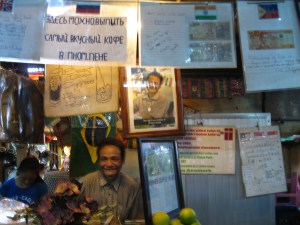
Best coffee in PP
We also went for “Khmer glamor shots”, where we went to a photo studio to get dressed up in formal Khmer clothes after about an hour of hair and make-up. (This would be done by locals for things like wedding or engagement pictures, so the shop no doubt thought we were bizarre.) It was a lot of fun!
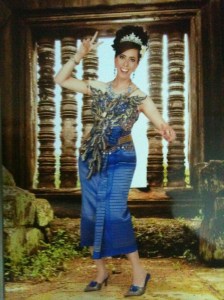
Me in traditional Khmer clothes photoshopped to Angkor Wat
I didn’t manage to go to Wat Phnom, as that side of the city was the gathering point for three days of protests. (There have been a lot of protests recently, and some violence, but these in particular were focused on protesting irregularities during the recent elections and called for an independent international investigation.) I was a good little traveller and stayed away from the large groups protesting, but I certainly saw the large military police presence and water canons in other parts of the city. Luckily, most of the time I passed the soldiers, they were sleeping in hammocks in the shade.
Of course, no visit to Phnom Penh is complete without a visit to Tuol Sleng Genocide Museum (former school turned detention and torture center S-21 during the Khmer Rouge) and the Killing Fields (merely one of many locations where people were killed and buried in mass graves, located outside the city).
The Khmer Rouge, led by Pol Pot, was a Cambodian Communist party that was in power for slightly under four years in the 1970s, renaming the country Democratic Kampuchea. I’m not sure where Pol Pot’s particular brand of communism came from, but it was particularly brutal. Pol Pot believed in the supremacy of the peasant, and in three days the Khmer Rouge resettled everyone living in Phnom Penh to the countryside to lead agricultural lives under near-starvation conditions. Education was essentially abolished. The mass relocations, hard working and living conditions, and killings of various groups of people led to between one to three million deaths in under four years. To put this in perspective, today’s Cambodian population is less than fifteen million people. What I didn’t realize is that the Khmer Rouge remained (at least nominally) the official government during the years post-Kampuchea under the Vietnamese and still exists as a party today, even as some of the 1970s leadership is being tried by a a special court.
S-21 is a peaceful place now. The sun shines in the courtyard. It’s a museum dedicated to education, with the hope of preventing future atrocities. Once you enter some of the rooms in the museum, it doesn’t take much imagination to see it as a detention center. One building still has the layout of the rough cells built in each classroom, barely bigger than a man stretched out lying down. Rooms full of “mug shots” of detainees make an impact, in part because the rooms just go on and on. I was most touched by the building which kept barbed wire on the balconies to prevent prisoners from committing suicide. Just standing behind the wire made me feel claustrophobic.
As for the Killing Fields, I had had mixed feelings on visiting. The monument to the dead there contains hundreds of bones, and I had heard that some people object to it as it doesn’t follow the rules of Buddhist burial. However, I did decide to go, to learn more and to honor the dead. The audio guide is great, and obviously heart-wrenching. If you didn’t have the guide, you honestly wouldn’t know that the site was anything more than a green area with oddly shaped pits (mass graves whose bodies were exhumed, so that the earth has collapsed). They are still finding bone and clothing fragments today, especially after the rainy season disturbs the ground.

Mass graves

Killing fields memorial
The Royal Palace provides an attraction that avoids dwelling on the dark days of the Khmer Rouge. I hired a guide at the gate, though in retrospect I don’t think it’s at all necessary. It was interesting to hear a bit about his life though!
And for the foodie, Phnom Penh has a variety of good cafes and restaurants. I went to the Friends training restaurant (and their shop, afterwards!), which was really good. The Shop had delicious chocolate mousse. A cupcake shop made beautiful confections. My friend took me for tasty Khmer barbecue, where I bravely tried bee larvae. (Tastes like creamy honey.)
Of course I had to take a cooking class! I actually took it on my way from Ho Chi Minh City to Siem Reap, stopping for the day in Phnom Penh to break the trip. We had a great group of people, and learned how to make fish amok, spring rolls, dipping sauce, banana petal salad, and of course a sticky rice and mango dessert. The amok we steamed in banana leaf boats – big impact with a few easy folds. As for the sticky rice dessert, it’s amazing how different the variations are in each country. Khmer food is on the sweet side, so for this dish, we made a caramel which we mixed into the rice.




 trails untrod