Heading to Melbourne

I had another encounter with kangaroos on Wednesday, this time, I must admit, as dinner in the Queen Victoria night market in Melbourne.

I flew from Sydney to Melbourne in the morning, arriving at my hostel around lunch. The Skybus is easy to find at the airport and goes express to Southern Cross station. Trams going around the CBD area are free (which, can I say, is fantastic), but I opted for the 20 minute walk to start to get a feel for the city.

I’m staying on Flinders Street, right across from the beautiful Flinders Street Station. I lucked out with an upgrade to a private room with en suite bath. While I wouldn’t have minded meeting some new people, I really do appreciate my own bathroom. While I was waiting to check in, I grabbed some lunch at one of the plethora of tiny restaurants in Degraves St right around the corner. Turns out it’s one of the quaint laneways Melbourne is known for. So many options for food – Asian noodles, sandwiches, Italian food, doughnuts, and, of course, coffee everywhere – and lines that reflect how popular some of these places are.

I grabbed a sandwich to eat on some steps in Federation Square, giving the stink eye to more seagulls who kept approaching hoping to steal some lunch. Then I grabbed a lot of brochures at the tourist office and learned to my dismay that getting to Phillip Island would be next to impossible this time of year via public transit. If I wanted to see the penguin parade, I would have to book a tour.

So I did. I returned to the hostel, got that tour and one for the Great Ocean Road planned, and picked up my complimentary tickets for Sea Life Aquarium and the Eureka Skydeck (complimentary since I had booked two tours).

Sea Life has some wonderful animals, including an enormous salt water crocodile and delicate sea horses. And there were two baby king penguins, as tall as the adults but roly poly and covered in grey fluffy down. The aquarium also is right on the river, with a lovely view.

20160601020859

I walked to Eureka Skydeck (the tallest building in Melbourne), getting a little lost and circling around the whole Melbourne arts block before arriving there. Looks like there are some good exhibits and performances coming up! Even with getting sidetracked, I made it in time for sunset.

After, it was time for dinner. Queen Victoria Market is not normally open in the evening, but I lucked out in that there was a Wednesday night market.

I followed the streams of people to find this rather overwhelming sight. So many people! And food stands of many varied cuisines – Sri Lankan, Vietnamese, Creole, Italian, and one “outback” food stall. Of course I had to try that, and ended up with a strongly spiced grilled kangaroo sandwich. I can’t say that it tasted terribly exotic, but it was tasty.

Hunter Valley

Much too early in the morning, I joined a Grey Lines tour out to the Hunter Valley for a day of wine tasting. The Hunter Valley is the oldest wine-making area of Australia. I’ve mostly been drinking wine from West Australia before this trip, so I was interested in trying wine from a different region.

I learned that I’m not a big fan of Australian semillon wine, at least from that region. (I tried three, so I think it’s a fair selection to base that statement on.)

The trip out to Hunter Valley took a couple of hours. It was amazing that scarcely more than an hour out of Sydney, you see completely wild, wooded areas of bush.

We started at a boutique winery called Ernest Hill, where the wonderful Leslie had us taste a range of about 7 wines, starting with semillon and verdelho, going through Merlot and Shiraz, and wrapping up with some dessert wines.

Our driver had hoped to show us some kangaroos, who often lie down between the rows of vines in the vineyard, but apparently it was too warm. No luck on the way in, though some people on the other side of the bus saw one hopping away in the distance.

Our next vineyard was attached to Two Fat Blokes restaurant, where I had the white wine tasting lunch. Lots of good food, paired with a semillon, verdelho, and Chardonnay from the winery out back. I skipped the additional wine tasting as we had one more vineyard to go!

We headed to McGuigans, for another set of tastings. They have award winning semillon. Still not my favorite varietal, though it might be good with seafood. It is quite acidic, though we did try the very young wines which was a factor in how acidic they were.

We then had a stop at a touristy set of shops near Hunter Gardens, called (I think) Hunter Village. I’d have been happy skipping this stop, as it seemed like it was primarily designed to separate tourists from their money. In all fairness, it worked with me, as I found a great little indy bookstore where I bought a book about bush nurses.

Our wonderful driver/guide Rusty really wanted to show us kangaroos, and drove down a side road for a few minutes on a hunch there might be kangaroos there. And there WERE!

Words are not sufficient to describe seeing these in the wild. They are such almost mythical beasts for those of us not from Australia. It was a perfect end to the day.

Bondi to Coogee

In keeping with the previous day’s theme of Sydney suburbs, I headed out to the famed Bondi Beach. Beautiful sand, glorious breakers, and a several mile coastal walk along the cliffs. (I’ve since been told that Bondi is overrated and too commercial, which I could see as being the case during the summer, but in late fall it was lovely.)

The coastal walk is absolutely gorgeous. Sydney and its environs are built on sandstone, which I assume accounts for the unusual shapes of the cliff face. I had been worried about my fear of heights being a problem during parts of the walk, but it was fine. More at issue was my being fit enough to climb all those stairs!

The shorter walk, with more of the dramatic scenery, is from Bondi to Bronte Beach. I decided to go the full route to Coogee, however, and even did part of it twice as I had dropped my fleece and had to go back to find it!

It was a lovely outing, wound up by some fish and chips that I almost got mobbed by seagulls for.

Paramatta

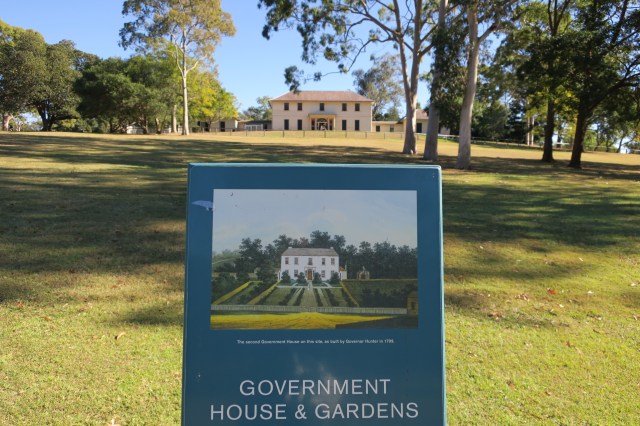
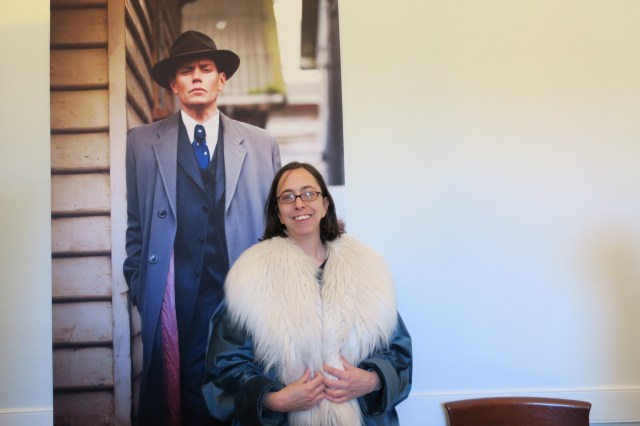
On Sunday I ventured into Sydney’s suburbia, to the town of Paramatta. There is an Australian mystery series called Miss Fisher’s Murder Mysteries that takes place in 1920s Melbourne. The costuming for the show is quite incredible, and there is a costume exhibit making the rounds of several Australian cities. Currently it is on display in the Old Government House in, you guessed it, Paramatta.

I lucked out, as Paramatta is located on the Paramatta River, and is therefore accessible by the ferries that are part of Sydney’s Public transit network. And on Sunday, the maximum amount an Opal Card holder can pay for the day is $2.50.

Despite the cold, I sat outside in the ferry for the hour plus ride, getting a magnificent view of Sydney Harbour.

From the website and map I’d picked up at the Visitors Centre, I’d expected a quaint old town. Not so much. It’s very much a modern suburb, and rather quiet on a Sunday morning. However, once I got to Paramatta Park and saw the beautiful Old Government House, I was happy.

20160528212356

The exhibit was great, letting you touch swatches of the fabric used for some of the dresses. Other outfits were vintage 1920s, including a constable uniform that the character Constable Collins wears. There’s a quote from the actor about how uncomfortable it is, which is funny when put in context with certain scenes from the show. There were even not one but two dress up rooms:

20160528221756

After the exhibit, I walked around Paramatta Park to the old Dairy Cottage, enjoying the greenery and families playing. Somewhere in that park is the presumed site of the first European farming in Australia.

Since I was all the way out in Paramatta, I decided to visit another house museum that had looked entertaining from the brochure, Elizabeth Farm. It was supposed to be an interactive museum in one of the oldest remaining European structure in Australia. Unfortunately it wasn’t as interesting as I’d hoped, perhaps because it was a quiet Sunday afternoon and I was getting tired. It looked like it would have great tours for school children, however.

Since the ferry only goes every hour on Sunday, I hastened back to the wharf and on to Sydney. Coming back into the Harbor, we saw magnificent views.

A rainy Saturday

Saturday morning was rainy and chilly, so I decided to use my Sydney Living Museum pass and check out two other museums located near Circular Quai. The closest, which is only open on the weekends, was the Justice and Police Museum.

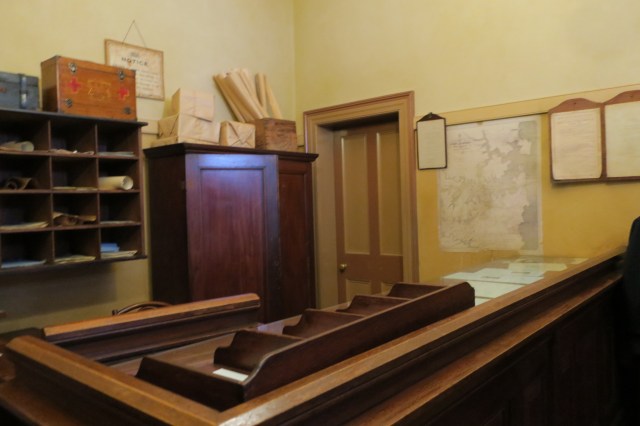
I figured it would be a quick walk through but ended up taking a guided tour, which gave life to the old building and cases that were discussed. My favorite room was the old front room of the police station, redone as it might have been in Victorian Sydney. I half expected to see Constable Collins from the Miss Fisher’s Murder Mysteries step into the room!

20160527215012

As it was still raining a bit, I visited the Museum of Sydney that was just up the road. Compared to the other two living museums, this museum just felt a bit slight. There wasn’t much there. Historically, the site is important, but the other museums do a better job of bringing the past to life.

The rain having stopped, I headed over to the Rocks, as I needed to stop by the Visitors Center and also needed some lunch. Lunch actually became tea as I stumbled across the Tea Cosy, which stated that it had the best scones in Sydney. I don’t know if they’re the best – I haven’t completed the experiment yet! – but they were piping hot and tasty.

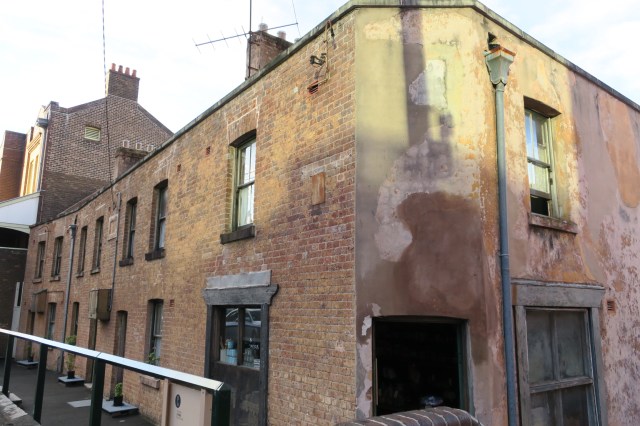
After completing my errands, I figured I might as well visit the last museum that was part of the Sydney Living Museums pass, the Susannah Place Museum. This museum, similar to the Tenement Museum in New York, showcases rooms furnished in a historic manner in the setting of an old building that has not been restored, but rather left to show the changes and layers of time. It’s an archeological site of social history, if you will. For example, one kitchen floor was peeling so that you could see the layers of newspaper under lino that had been placed there as insulation.

Susannah Place is very special, in that these buildings are 170 years old (built in 1844) and pretty much at least one if not all of the residences were occupied until it became a museum. For a young country like Australia, that is a large portion of its European (as opposed to indigenous) history. (It’s been interesting and a little odd being in a nation younger than my own – I am so used to traveling places that have a long and storied history of nationhood.)

20160528015731

I took another free walking tour, this one of the Rocks, and then wandered about admiring the displays for Vivid. Vivid is a several week long festival part of which centers around light displays around various parts of the Harbor and CBD. The Opera House had about a 20 minute loop where the sails transformed into one magical landscape after another, a bright end to a grey day.

I’m Back!

It’s been a few years, but I’ve finally gotten the opportunity for another lengthy trip! Not part of a year of adventure, but a month long trip to Australia and New Zealand. Not too shabby in the adventure front!

And I must admit that I am woefully out of practice for long haul flights. My rear has still not completely recovered from sitting for much of 28 hours of travel. New York to LA, thence to Sydney. But I was fortunate in getting the bulkhead exit row seat that lets you stretch your legs, so I really can’t complain.

Tired and jet lagged, I took a few minutes to acclimate in the airport. It was both weird and wonderful to have spent so long traveling to wind up in a country where I can understand the signage and the language. Well, I can understand the language just fine barring any specific thick accents, but really, that’s the same in the States too, isn’t it? Usually when I arrive somewhere after a transpacific flight, I have a huge language barrier to deal with as well. It was lovely not to have to deal with that.

I got a map and directions on buying an Opal card (Sydney public transit smart card) from the lady at information and headed to the train. The train downtown (or to the CBD – central business district – as the Aussies call it) was easy and straightforward. Once off the train at Circular Quai, I could see my hotel, which made getting lost a non-issue.

On check-in, I was upgraded to a room with a harbor view, plus a wombat magnet! Marriott has never given me a magnet before – this stay was off to a promising start!

Eschewing a nap, I hoped my shower would wake me up enough to face the day. The sun was shining brightly as I ventured out. My hotel is very near the Rocks, which is lucky for many reasons, not least of which was that it allowed me to stop by the Visitors information center, stumbling onto a self-professed foodie market on the way.

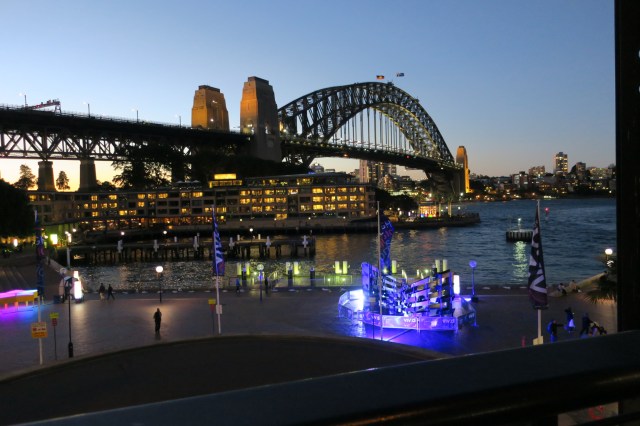
After loading up with more brochures than was good for me, I decided to wander around Circular Quay to the Opera House and then head to the Botanic Gardens. What can I write about Sydney Harbor? The hype is true. It is absolutely gorgeous especially under a clear blue sky and the strong Australian sun. I’m hoping I can see a performance at the Opera House before I fly back.

I wandered into the Gardens. I had missed the guided tour but frankly my brain capacity was next to nil anyway due to fatigue. I admired the huge trees and was taken aback by screeching parrots? Cockatoos? I’m not entirely sure what the birds were but they looked exotic and strange, even if they sounded like nuisances. I also saw boat loads of what I later found out are ibis. 

I was planning on taking a free walking tour in the afternoon, so I exited the Royal Botanic Gardens and headed towards Hyde Park. On the way, I passed a number of beautiful buildings that looked to date from various parts of the 19th century. I later found out that several of the buildings were part of the old Rum Hospital, so called because Governor Macquarie in the early 19th century allowed several merchants a short-term monopoly on rum sales in exchange for them building the hospital. An interesting origin story, though I can think of several for a name like that!

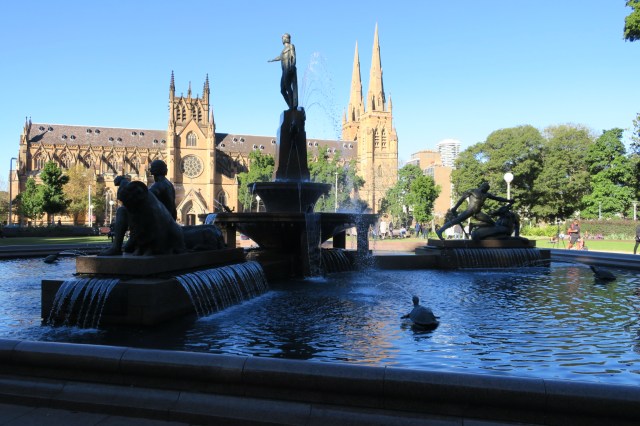
Right at the edge of Hyde Park, I caught sight of another well proportioned early 19th century building, the Hyde Park Barracks, balanced by the similar architecture of the church across the road. Behind and to the right, tower spires rose, reminding me of English church architecture.

The Hyde Park Barracks are one of Sydney’s Living Museums, music to my ears as I love finding out about social history. I have to say this museum is one of  best interactive museums I’ve seen, especially for a history museum (as opposed to a science museum). The ground floor exhibit on convict life encouraged you to dress up as a convict, leg shackles included!

Hyde Park is another beautiful green space that Sydney seems to abound in.

20160526235539

I finally made my way to the town hall for the walking tour, which covered much of what I had seen on my way there. Luckily we did see some other buildings like the QVB (Queen Victoria Building), an (appropriately) Victorian building. There is a statue of the queen outside, and her little dog too. I mention the dog because it has a separate statue all its own, and…it talks. (Apparently it raises money for charity.)

The afternoon wrapped up with sunset views over the Harbor. I’d already gotten the impression that I was going to love Sydney, and those views didn’t hurt! I headed back to the hotel and was asleep before 8pm.

20160527032213

The Wonders of Angkor: Afternoon at Angkor Wat

Me at Angkor Wat

Me at Angkor Wat

The layout of Angkor Wat itself is very symbolic, not surprisingly. It has three levels, representing Hell, Earth and Heaven. Pools abound. And nothing quite prepares you for the scale of the thing – it is enormous!

The first level of the temple has four different series of bas-reliefs, primarily covering a variety of Hindu stories. Sadly, you can see where people keep touching the stone, as it has changed color. (Granted, it can make it a little easier to see the contrasts!) Some of my favorite carvings were of the monkeys.

While that first level may be the most interesting artistically, there are breath-taking views everywhere.

Level three – Heaven – is at the top of the temple, and you can walk around the base of the five towers that make up Angkor Wat’s iconic silhouette. It’s no mean feat going up there, however, and while I made it up just fine, I had some difficulty going down. Let me put this in perspective. One “level” is many stories high, and the stairs, once again, are at about a 90 degree angle.

I made it up and down these crazy high stairs!

I made it up and down these crazy high stairs!

I wasn’t going to let something like a severe fear of heights prevent me from seeing something I’ve wanted to see for years! And thank goodness for my friend’s help – a travel buddy is a must when you need to face your fear.

We headed out of Angkor Wat, admiring more vistas as we left to kill some time with a beer at the foot of Phnom Bakeng, where we planned to watch the sunset. Unfortunately, several hundred other people planned on watching the sunset with us, so I didn’t get a very good photo of the sunset itself. But some friendly young monks posed for me, and I had a great view of Angkor Wat in the setting sun, so it was still worthwhile!

The Wonders of Angkor: The First Morning

My Park Pass

My Park Pass

I was a little worried that I would be disappointed when I went to Siem Reap to explore the various temples in Angkor Archeological Park, because I had such high expectations at the very least for Angkor Wat, not to mention the other temples. But it completely lived up to expectations! It really is as spectacular as all the hype about it, amazingly enough. Get ready for a lot of pictures, because even though I pruned what I decided to post, it was impossible to prune enough!

I had left Ho Chi Minh City for two nights in Phnom Penh, where I took the cooking class I wrote about earlier and met another American who was traveling to Siem Reap as well. We decided to share a guide and driver for our first day in Siem Reap, when we visited much of what is called the “little tour”, encompassing Angkor Wat, Angkor Thom (including Bayon), Ta Prohm, and a couple of other shorter stops. Exhausting but fabulous!

Me at Ta Prohm temple

Me at Ta Prohm temple


We started out the day with Ta Prohm, the temple featured in all the postcards of banyan trees growing into or on the temple, and also known for its cameo in the Tomb Raider movie. Seeing the trees was amazing. Given how big they are, they must be incredibly old. Here and there, they are pushing the temple stones away, but in other places, it looks like they are supporting the temple. Ta Prohm also has some lovely carvings. Something you see throughout the various Angkor period temples (and on some of the earlier temples) is figures of dancers, called apsara. I was told the various poses of the dance reflect the steps of planting, growing and harvesting rice.

We headed towards Ta Keo, but unfortunately they were working on maintenance/restoration and had closed it off for the day. I was ok with skipping one set of super-steep stairs as I suspected there were many more to come!

Ta Keo

Ta Keo

Next we entered the Angkor-era royal city of Angkor Thom. Angkor Thom’s walls are well worth seeing, as the various gates consist of monumental stone heads representing the king or a god, and there are several terraces as well. Then within the walls lie a number of temples and royal buildings, the best known of which is Bayon. (Yes, that would be the monumental head temple – forty or fifty of them, I’ve heard.)

We entered through a victory gate:

and continued on to Bayon. Bayon is a bit of a contrast, because not only does it have monumental sculpture at the top of the temple, but it is surrounded by some of the finest carvings from the period. These carvings show scenes of going to and coming from battle:

But the morning wasn’t over yet! The next temple to explore was Baphuon. Climbing it was…interesting, for someone scared of heights. (The stairs are awfully steep!) There aren’t really major carvings with this temple, but a great view from the top.

Interestingly, the back of the temple itself forms a “statue” of a giant reclining Buddha. Can you see the curve of its face on the left?

We passed the ancient seat of the king, the only part of the palace to be built in stone, apparently. All of the other non-religious royal buildings were built of wood and no longer exist. I passed on climbing up this one.

We headed out of Angkor Thom through another gate and onto the Elephant Terrace, where the king apparently watched elephant fights eight hundred years ago. At this point it was time for lunch, before heading to spend much of the afternoon at Angkor Wat. We ate at one of the touristy restaurants across from Angkor Wat, nothing too great, but not bad Khmer food. Fresh coconut juice drunk directly from the coconut helped to fortify us for the afternoon – when people mention how hot Siem Reap is, they aren’t kidding! Very, very hot and humid.

Paris of the East: Ho Chi Minh City/Saigon

Lots of massive official posters around the city...

Lots of massive official posters around the city…

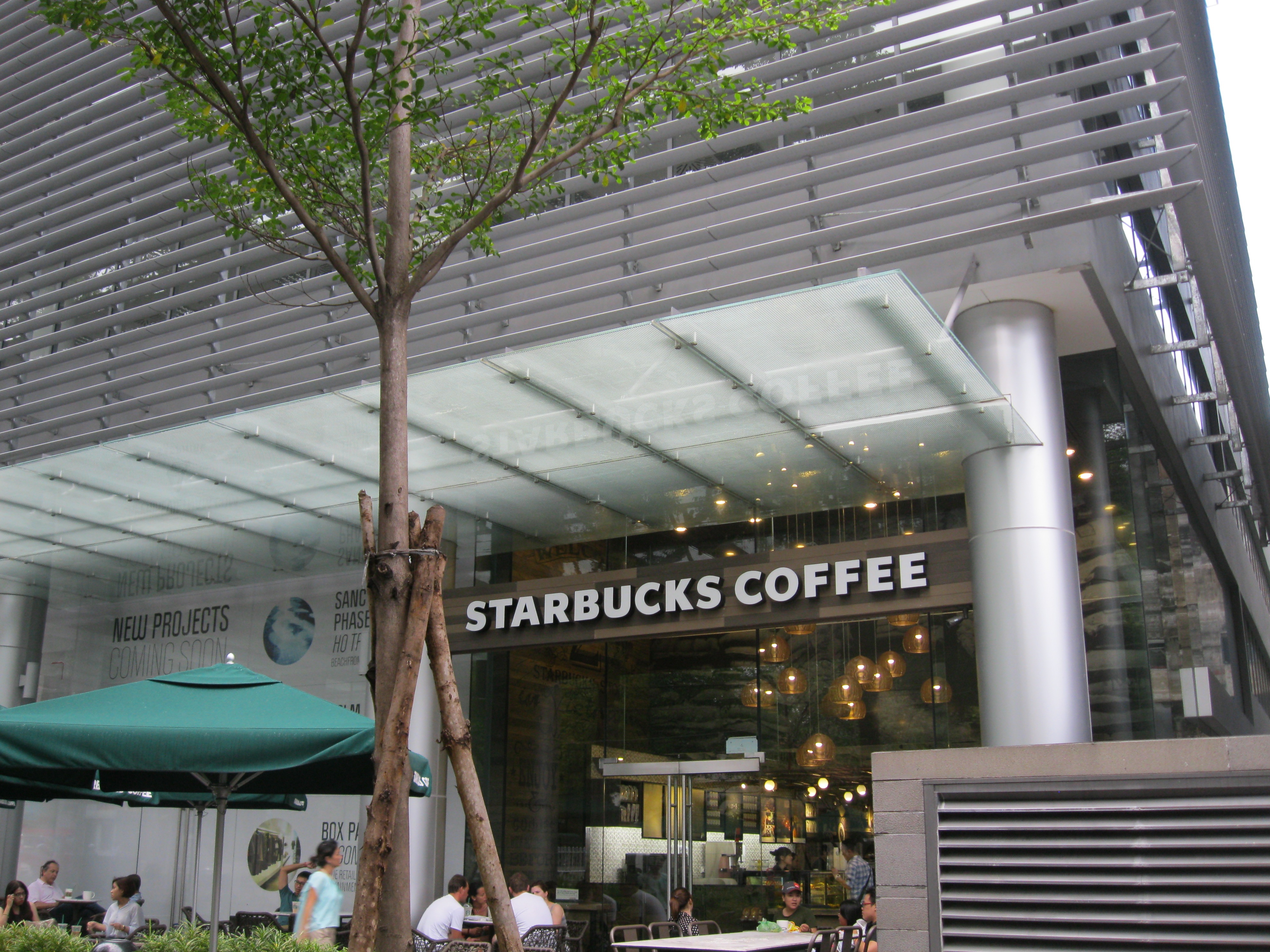
Once called the Paris of the East, Saigon has gone through a lot in the past forty years. I’ll admit that in spite of trying to not bring preconceptions with me, I definitely had certain expectations for Ho Chi Minh City. Arriving on the bus from Phnom Penh, the first of those subconscious ideas disappeared as we passed a huge Starbucks not too far from where I got off the bus. Now to be fair, I believe that Starbucks has only broken into the market quite recently, but I saw it as emblematic of the Ho Chi Minh City I got to see, which was much less closed to the West than I had realized. Apparently the past few years has seen a rise in the spending power of the middle class, while the trendy children of Party members don’t lack for Western luxury stores like Chanel or Louis Vuitton.
Starbucks

Starbucks

I stayed in District 1, and, apart from the Hunger Games-like nomenclature, it’s a great area for tourists to stay. The tourist sites are here, along with the previously mentioned luxury good stores. Architecture is a mix of very new skyscrapers, well-preserved French-style city and government buildings, some modern Vietnamese buildings, and not so well-maintained colonial buildings. Traffic, however, is like the rest of SE Asia – terrible and frightening for Westerners not used to different rules of the road. (OK, to me they seem like no rules of the road!)

I visited the city so that I could see an old friend of mine from university, and we had a great time! Sadly, two months wasn’t really enough time to visit Vietnam on top of Laos, Cambodia and Thailand, so the rest of the country will have to wait for another visit.

My friend Va and I spent my first evening in town eating and walking around. My kind of vacation!

District One at night

District One at night

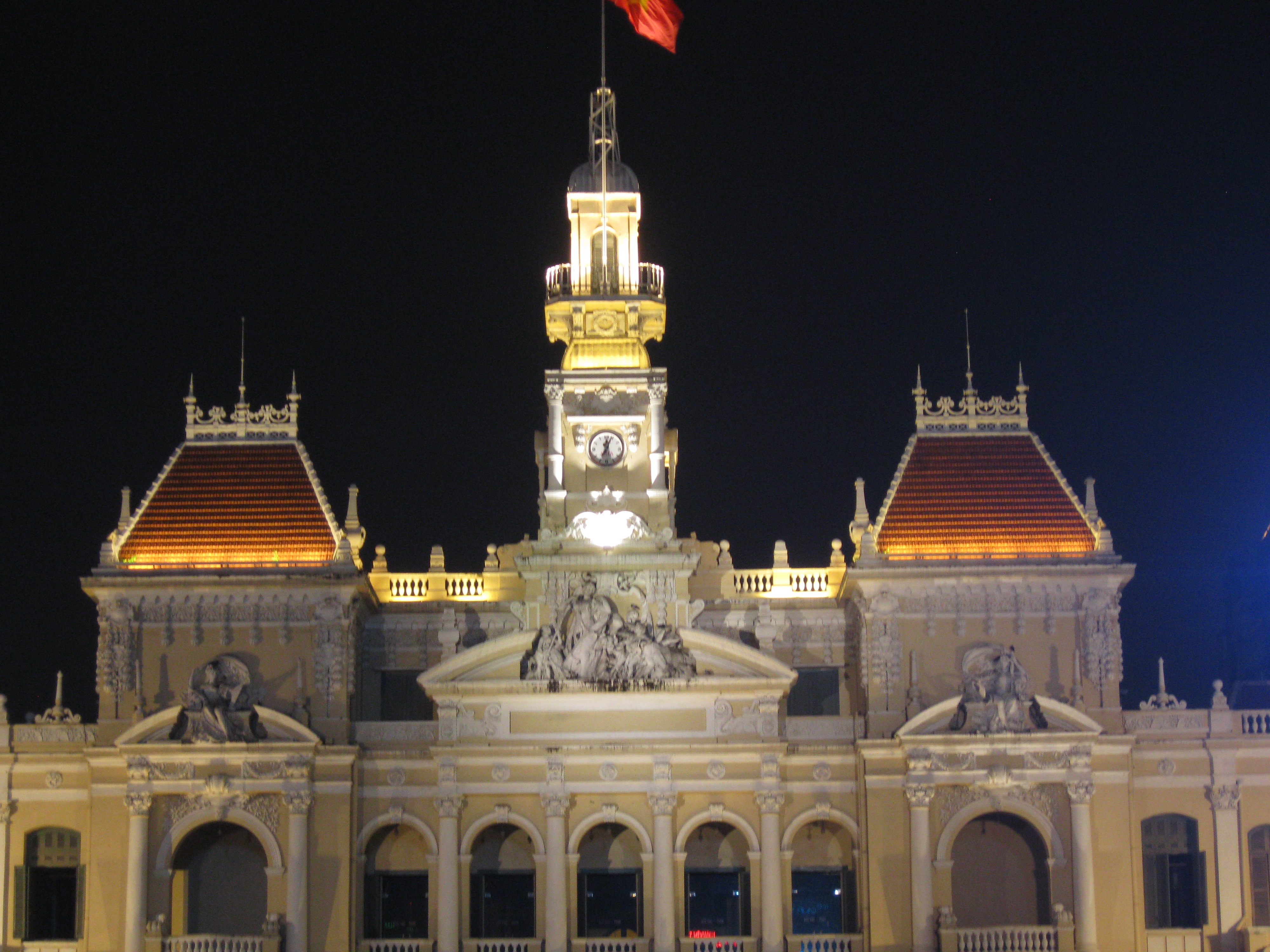
The HCMC People's Committee Building (former Hotel de Ville de Saigon)

The HCMC People’s Committee Building (former Hotel de Ville de Saigon)

In fact, that was a theme for much of the trip, along with sitting in coffee shops and writing. (Yes, I am still about two weeks behind in my blog.) I really liked the architecture of the city. The Basilica de Notre Dame seems rather incongruous in SE Asia – almost as if it had been transplanted whole from France. The central post office (apparently open every day of the week) was designed by Gustave Eiffel. Newer buildings are, not surprisingly, designed by Vietnamese.

One morning, I took a Vietnamese cooking class. I really like Vietnamese food and was super excited that I would be learning how to cook caramel pork in clay pot, since caramel fish in clay pot is one of my favorite dishes. Sadly, my course was the worst that I have take on this trip, leaving me feeling like I was helping in someone else’s kitchen rather than being able to cook things myself. For example, for the caramel pork, they had already made the caramel sauce. How disappointing! At least I learned how to make a decent sweet and sour soup.

Luckily the day was redeemed by a combination of great street food (green papaya salad) and my friend’s persuading me to join her at her ballet class. I haven’t taken ballet in about, oh, eighteen years, so it wasn’t pretty. But it felt good! We celebrated after with some crepes, undoing all our good exercise but rewarding our tastebuds.

My friend Va and the fabulous papaya salad

My friend Va and the fabulous papaya salad

Fun at La Creperie!

Fun at La Creperie!

I did spend part of a day in the former Presidential Palace. It was sobering to visit the basement, which was essentially a bunker/command center. It didn’t take much imagination to put you back to the final days before the fall of Saigon. Walking through, there isn’t much sign posting, which I was fine with since I could figure out most things from the map. There is one room full of pictures detailing the history of the palace and the “glorious reunification” which was full of the expected Communist propaganda, so I was glad to have opted to bypass the official tour.

Va and I also ventured to Cholon, Chinatown. We tried to find some food, but to no avail, so visited one of the pagodas and hastened home to avoid the afternoon rain.

I was sorry to leave, even after having extended my trip by a couple of days.

Kampot Pepper and Kep Crab

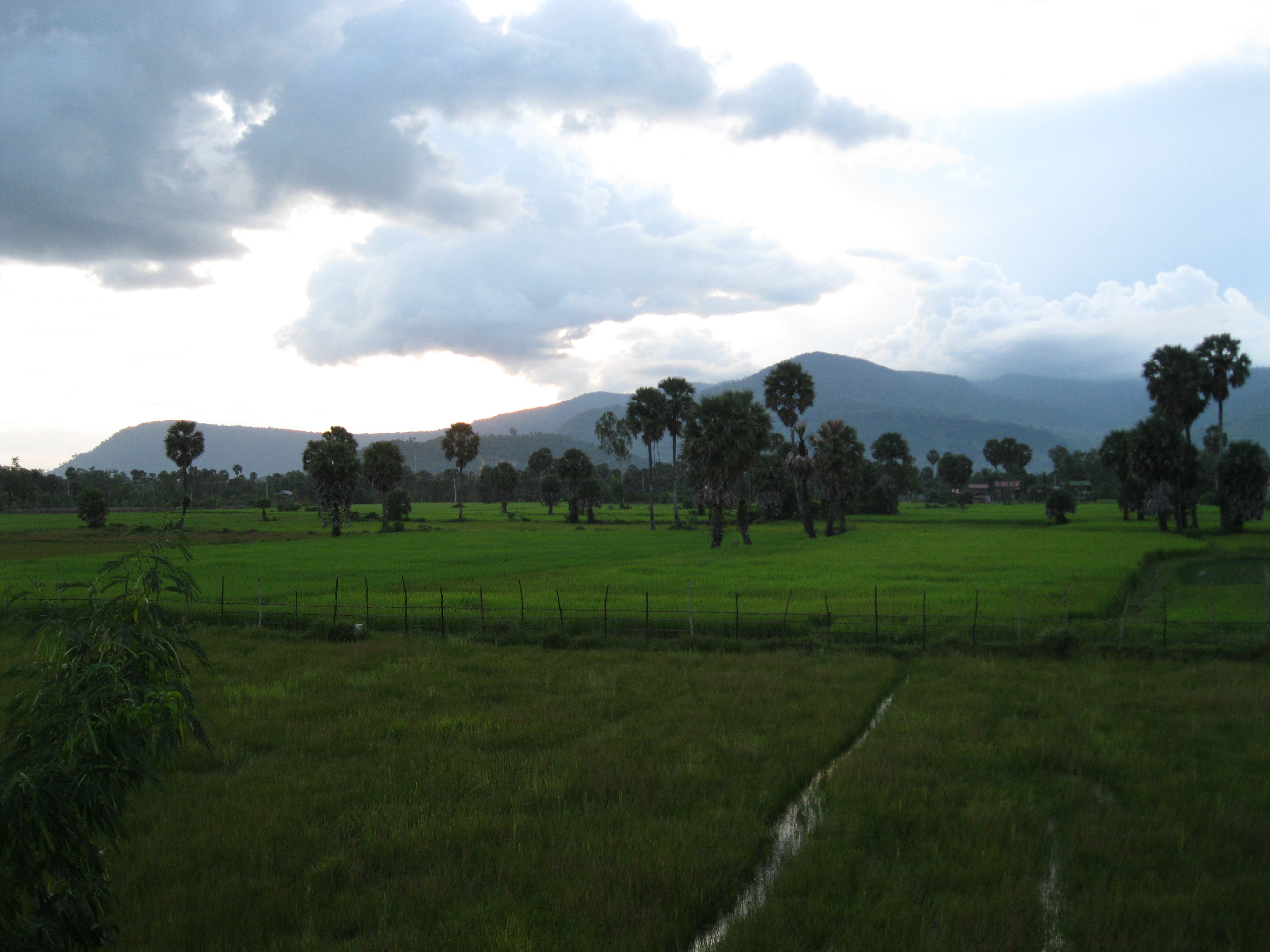
A few days into my stay in Phnom Penh, I took a friend’s advice and headed south to Kampot. Because of the recent rains, the rice fields down by Kampot were a vibrant green, contrasting with the red of the dirt roads. It was absolutely beautiful!

It’s a little far to Kampot to make a day trip from Phnom Penh, so I planned on staying one night at an eco resort nearby. Stepping off the bus, I was swarmed by the most aggressive tuk tuk drivers I have met yet in Cambodia, who physically surrounded me. That made me uncomfortable, so I walked away and picked a single driver who followed quietly. One of the aggressive ones chose to dispute this, saying he had told me “I wait for you”, a pretty standard tactic. I ignored this and left with the non-hassling driver, but it wasn’t the most auspicious start!

The roads in the area are full of potholes, making the tuk tuk a fairly uncomfortable mode of transport. But all the potholes mean driving at a slow pace, which enabled me to wave back to the various schoolchildren on their bikes shouting “hello” and “how are you?” throughout the day. The kids were so friendly! It’s one of my favorite memories of Cambodia.

To get to the hotel, you have to go through a tiny Cham (a Muslim ethnic group) village, barely avoiding driving through someone’s sheltered “patio” under their second story house because the houses are so close together. Chickens, of course, abound.

I hired my tuk tuk driver to take me to Kep, on the ocean, and to a temple built around a stalactite in a cave. I had also wanted to see a pepper plantation, since Kampot pepper is a specialty. Back in the French colonial days, it was exported as a delicacy, and it is enjoying a resurgence now that the civil war is over. My hotel said the plantations should be on the way, but my tuk tuk driver had a set “tour” which included salt flats, Kep crab market, the temple, and a fishing village and he wasn’t too interested in being flexible. Oh well, I have seen a lot of fields on this trip anyway!

First stop were the salt flats, not too active yet since it was still rainy season and all the salt would keep getting diluted and washed away if they were to try to dry salt!

Salt fields without salt

Salt fields without salt


Next was Kep crab market, where I gently refused to eat at the restaurant my driver suggested and went to the one that had been recommended to me instead. Lunch was, of course, crab – steamed and with fresh Kampot pepper. Just sitting and looking out at the sea was really lovely.
Crab with Kampot pepper

Crab with Kampot pepper

Crab fishing

Crab fishing

Playing

Playing


Then back in the tuk tuk past the fishing village (looking over a group of men with boats getting their nets ready for the night’s catch, nothing too exciting) and on to the temple. What I didn’t know was that in wet season, tuk tuks can’t get to the foot of the hill the cave is in and you have to walk through some rice paddies and across a downed tree set as a bridge. Despite all my good intentions, I had to accept the help of a couple of local children as guides. (I was really reluctant to since it can encourage the families to send the kids to act as guides to earn tip money instead of to school.)

Through the fields, over the tree, up the hill, then down into the (mosquito-filled) cave. A bit of a trek! The temple was tiny, more a shrine, but really interesting for all that. It was a simple brick structure built around the cave formation.

Cave temple

Cave temple


Then back to the tuk tuk, where the driver made me clean off at least some of the mud caked onto my shoes from the trek over the dirt path. One of the kids had giggled that my shoes now weighed a kilo each due to mud, and she wasn’t far wrong!

An early night was in order, as I was just starting to get that horrible head cold. My eco resort had a choice of room types. I chose the tribal hut, a bamboo hut on stilts at the back of the property overlooking rice fields. I left my shoes at the bottom of the ladder up to my hut, as asked to make cleaning the elevated bamboo platform easier. I awoke in the middle of the night to the sound of a wet season downpour, and debated going out to rescue my shoes. But they would have been soaked already, so I decided to stay snug and dry. In the morning, I shook them out and was a little bemused to see a toad plop out of one! image

The hot tropical sun dried my shoes over the course of the morning, which worked perfectly since I had decided to nurse my cold by reading my book at the hotel. Why else stay at an eco resort, after all, if it’s not also a good place to hang out?!

And then back to Phnom Penh!