Street Art!

On Saturday, I took a local non-profit named Graffitimundo’s Hidden Walls tour of Buenos Aires to discover the grafitti – more specifically the street art – in four different barrios. We went to the dodgy neighborhoods, La Boca and Barracas. We also stopped in Congreso and Palermo. I have to say, I didn’t realize how good street art could be. I like much of what we saw more than much contemporary art I’ve seen. (Of course, that’s kind of damning with faint praise.) I was impressed, both with the tour and with what we saw. I learned about stenciling versus free-hand and even saw a street decorated with mosaics in an attempt to make it brighter and more cheerful. Real graffiti is a relatively new phenomenon in Argentina, given that there was a military dictatorship during the time most other countries were developing it. I don’t remember every artist’s name, but several are supported by Graffitimundo and will be on their website.

Anyway, enough history! Judge for yourselves whether you like it or not:

This slideshow requires JavaScript.

The Many Colors of La Boca

Last Thursday, we had a Spanish class field trip to La Boca, the gritty, colorful, formerly bustling port barrio that welcomed waves of Italian (mainly Genoese) immigrants in the 19th century. Those pictures of brightly painted yellow and blue and red wooden and metal houses that you see in brochures advertising Buenos Aires? That’s La Boca – and more specifically, that’s the area around El Caminito, a cool-looking tourist trap that is meant to be a living museum of what La Boca once was. Those poor Genoese dockworkers used leftover paint from the ships to brighten their abodes – thus the rainbow of El Caminito. Most actual houses in La Boca have lost these bright colors as the area became poorer. There are a lot of squatters and a lot of multi-family apartments in La Boca now, part of why guidebooks warn tourists from straying from the area right around El Caminito and the Bombonera soccer stadium.

Tourist trap or not, it was cold and a Thursday, so it wasn’t too crowded. We started off with a quick visit to the museum dedicated to Benito Quinquela Martín, a man who painted the ships of the port of La Boca and was instrumental in creating (recreating?) El Caminito as an homage to La Boca.

Then we froze more and walked along El Caminito and a street parallel. On the weekends, there are tango shows in the restaurants, which have tiny dance platforms so the dancers can attract customers. (I’m sneaking in a photo or two from Saturday, when I went back to La Boca to take a graffiti tour and there were actual dancers out there.)

People have told me that La Boca (by which they mean El Caminito) is over-rated. I’d honestly just say that you need to set appropriate expectations for yourself. There are only three or four blocks to see, but those blocks, especially when there aren’t too many tourists walking around, are bright and vibrant and lovely.

Dancing through Congreso

One of the women in the level two Spanish class has some connections here and was invited on a guided tour of the Congreso building while she was here. She graciously arranged for a group of us in the first three levels of Spanish class to go, so I got to explore in depth the imposing Congreso last Wednesday!

It started with a little bit of initial confusion, with nobody there to greet us as amazingly our group was closer to American time than Argentine time (aka a group of ten people actually arrived within just a few minutes of when they said they would). Eventually a guide and our fellow student’s contact arrived, and we found out that the guide only spoke Spanish. So anything after this paragraph, take with a grain of salt. I’m only at level one of Spanish, after all!

The guide handed out mini copies of the Argentine constitution to everyone, we went through security, and we were in! First stop, the official ceremonious doors and entryway, almost all of which was made from imported materials. In fact, that holds true for pretty much the entire building.

Next came the room with all the flags of the different provinces, with its stained glass roof under repair. Apparently it’s been under repair for a while, as every time bad weather arrives, the glass gets moved around by the wind. Sounds challenging, and like maybe they need a different way to fix the panels down.

Then came a super imposing room, the center of the building, the Blue Room. The Blue Room is located directly under the dome and houses the constitution (one of multiple original signed copies, if I understood correctly). There is a magnificent chandelier dripping in baccarat crystal and showcasing plaques on the metal part that represent eight or nine important moments in Argentine history. (I didn’t quite get the details on what those events were, however.)

We visited a room used by the senators to relax. It’s full of leather and the scent and atmosphere of old men, which may not be fair as I have no idea of the average senatorial age here – and there was only one senator in the building anyway as it’s between sessions right now. Another room was decorated in pink and was the equivalent room for women. Quite pretty and a nice thought for back in the day, though now, appropriately, both rooms are for both sexes. We disturbed a staffer of some sort having coffee in the pink room, but at some point he stepped out so we could then visit.

Next came one of the most amazing moments: we got to enter the Senate, sit in the senators’ seats, and even go up in the front of the room and sit in the Vice President’s seat. Everyone had been taking a ton of pictures of themselves posing in places during the tour – this was where I stopped taking pictures of just the building and posed myself!

Our foray into the Chamber of Deputies’s side of the building was shorter: we entered the (very large) Chamber and the waiting room in front of it. By now I think people were getting tired, as we had been there for quite some time what with the tour guide’s lectures and all the photo-taking. But we got to wrap up in my favorite room, the library! It was absolutely beautiful.

In fact it was all beautiful. It seemed very European, very 19th century, even though it dates from later than that.

We headed out as it grew dark, and I went off for dinner and then my first venture out to a milonga. La Viruta offers tango classes most nights of the week and is very welcoming to beginners (at least during the class – I got asked to dance several times by individuals who ran away when I told them I was a rank beginner. Not that I blame them. Too much.) I enjoyed it despite the fact that it was extremely crowded in the beginners class. After the classes, the floor opened for dancing (aka the milonga part of the evening) and I enjoyed watching some very good dancers tango. I even managed to not scare someone by my newness and danced!

Doors of Recoleta Cemetery

Tuesday morning saw me back at Recoleta Cemetery, enjoying the view (and getting scammed for a few pesos by the guy saying he was collecting for charity just outside the gates *mental head slap*). This time I got to see Evita’s family tomb as well (the Duarte family).

We got some good views in the bright sunshine:

And having seen posters everywhere showing doors of a city, here’s my attempt at doors of Recoleta Cemetery:

Out and About in Buenos Aires: Feria de Mataderos and Tango!

Sunday and Monday were busy, interesting days! I’ve realized that I don’t have a long time left in Buenos Aires (how time flies!), and I want to take advantage of it.

I had been intrigued by a description of a feria (fair or market) that takes place in the very southerly barrio of Mataderos. It’s known for its singing, dancing, and gaucho-related activities, along with artisanal food, drinks and crafts. The other advantage is that it’s off the beaten path, taking an hour by bus to get there. It was definitely worth it, though! I bought the best dulce de leche ever and had my first choripan (chorizo on bread). We heard live music and even saw people dancing a handkerchief dance to it. As seems to be common at ferias (at least, I also saw this in San Telmo), there was a table loaded with goodies baked by local women. Of course we had to try a piece of cake! We wrapped up the day with a little more shopping, at Ateneo, the prettiest bookstore ever.


On Monday, a group of us finally went to Cafe Tortoni to see a tango show. (We’d only been trying for a week!) We got a great view of the Congreso building while heading to buy tickets. Before the show we went to a parrilla in San Telmo. It was pricey but tasty. Unfortunately, dinner took a little longer than expected (oh so common with a group of people) and apparently my Spanish was not up to par, so we missed part of the show. (I could have sworn they said doors opened at 10, show at 10:30.) Oh well, everyone had fun at least, and what we saw of the show was fantastic.

Exploring Abasto and Congreso

On Saturday, I took a free tour of Buenos Aires that taught me how to use the bus system in BA. Apparently there is a bus guide that divides the city into a series of smaller maps, each map being divided into a grid. To figure out what bus you need to take you somewhere, you find what grid cell you’re leaving from, look up the list of buses for that box, then do the same for your destination. If any of those bus numbers overlap, you’ve found a bus you can take to the general area. Then you look up the bus route number in the back of the book to see what streets the bus will go down.

Statue of Garibaldi, Plaza Italia

Statue of Garibaldi, Plaza Italia


We hopped on a bus from our starting point of Plaza Italia to head towards the barrio of Abasto. First stop, Carlos Gardel’s house. (Carlos Gardel was the famous tango singer who made tango respectable – previously it was danced by pairs of male dockworkers in La Boca and in brothels.) While the house doesn’t really look like anything out of the ordinary, the street it is on has a number of houses decorated with the local painting style of filete. Filete is the filigree and flowers painted onto brightly colored houses (which tend to be red or pink or yellow).

We walked around a few blocks of Gardel’s neighborhood, soaking in the houses covered in tango music and the pavement blocks that held the lyrics to famous tango songs. One street had a little, red shrine to a gaucho not-quite-saint that was dedicated to someone who had died in an accident there. Our guide Jonathan pointed out the ribbons tied to the bumper of the taxi next to the shrine – red ribbons to the gaucho, red ribbons with words on them to a saint, and finally the Argentine flag. Down the block was a car with a pail of water on the roof – that is a sign that the car is for sale.
Shrine places where someone was in an accident - not dedicated to a saint, but rather to a gaucho legend

Shrine places where someone was in an accident – not dedicated to a saint, but rather to a gaucho legend


We then headed to Asbasto shopping mall, home to the only kosher McDonalds outside of Israel. Since it was Saturday, of course it was closed. (You may have guessed from this that Abasto has a big Jewish population, and you’d be right. And in fact BA is home to the fourth largest Jewish community outside of Israel, numbering around a tenth of the city.) Abasto shopping center used to be the central market for the city, and you can still see that from its architectural style.

We stopped in the food court for a snack (baked potato with ham and cheese, an unfortunate choice) and then headed down to the Subte. On our way out, we passed some tables with people applauding. Apparently Argentine director for 2010’s Oscar winning foreign film, Juan José Campanella, was there.

Next we headed to Congreso, the building which houses both chambers of the Argentine parliament. Apparently the building was modeled on the US one. It’s in a square full of Belle Époque buildings, opening onto the Avenida de Mayo and, in the far distance, the Casa Rosada. Avenida de Mayo has a bit of faded elegance about it, buildings in the Parisian style sometimes boarded up or graffitied. Jonathan pointed out to us one incredibly interesting building called the Palacio Barolo, built in the early twentieth century to house the remains of Dante when Europe faded into its inevitable and imminent decline (according to the Italian immigrant to Argentina who had it built). And in homage to Dante, the building is rife with symbolism, from how high it is to numbers of columns to the murals depicting Hell, Purgatory and Paradise. I think I may need to go on a tour and check out the inside for myself!

Our final stop was the Plaza de Mayo, after which I headed to see the inside of the cathedral. It’s lovely.

I wrapped up the day with dinner at a parilla and a housewarming party where I got to meet more international students. Hurrah for all these opportunities to meet new people!

Technical Difficiltes

Sorry all, the app decided to publish the last two drafts without my knowledge.

The post “Back in BA” has been updated with pictures and published. If you get email notifications of new posts, you may have missed the pics, so feel free to revisit it!

My post on Spanish classes has been taken down so I can finish writing it. Oops! Check back in a day or two and it should be up.

Embarrassing, but in my defense, I’m doing the whole South American part of the blog on a phone!

First Couple of Weeks of Classes

Last Monday, I went to CUI for the oral placement test. That was fun – not! It was a bit of an embarrassing exercise in futility – I’ve never studied Spanish before, so I figured that even with my knowledge of other Romance languages, I was going to be in level 1. And I was, but only after a few excruciatingly embarrassing moments similar to a nightmare where you’re up on a stage giving a presentation in front of a lot of people and you can’t say a word. Except it was real. (No stage, though!)

Tuesday was the first day of Spanish classes. I met some nice people, most of whom are college exchange/study abroad students. I really enjoyed spending time with language learning again. It’s been years since I’ve used that part of my brain! Tiring but worth it. Oh yes, and the guy came to fix the water heater. Did I not mention that? My gas water heater’s pilot light had kept going off at inopportune moments ever since I moved in to my apartment on Saturday. Luckily it was fixed on Tuesday so I was set the rest of the time I was in that apartment, but it made for an…interesting time taking showers and not knowing whether I’d have any hot water.

On the Wednesday, a couple of the girls in my class and I went to the Museo de Arte Latinoamericano de Buenos Aires, otherwise known as MALBA. It’s in a lovely, shiny modern building. Wednesdays are free admission for students and half off general admission, so there was quite a line. It moved pretty quickly though, so we got in in about half an hour (after some great people watching). Most of the museum was dedicated to a special exhibit by a Japanese artist who was very active in the sixties and seventies. She seemed to use polka dots a lot, and the museum had this fantastic interactive exhibit where they gave everyone a sheet of variously-sized colored circle stickers to put on themselves and on the walls and furnishings of a special room. Apart from the permanent collection of Latin-American art (two rooms, including a Frida Kahlo self-portrait), the sticker room was my favorite.


And then travelers’ tummy troubles hit and I decided to keep a low profile. Fact of life when traveling outside of developed countries – enough said. I did manage to move from my apartment in the older building in Palermo Soho back to the cozy little studio I had spent a few days in when I first arrived, in Palermo Hollywood.

I was feeling well enough by Sunday to meet some folks from my class and go to the San Telmo market (Feria de San Telmo). It’s blocks upon blocks of stalls ranging from tango-inspired art to matés to cheap touristy knick-knacks to slices of cake. We decided to share a couple of yummy slices of cake in the middle of the crowded, narrow street, then stepped into a side courtyard to listen to some musicians. A few blocks further, we detoured into a covered antiques market. It was a chilly day and we got to Plaza Dorrego, the heart of the quintessential San Telmo antiques market, right when they were packing up, so we warmed up in a coffee shop and headed home. On the Subte home, an older American gentleman heard us speaking English (the lingua franca among two Americans and two Norwegians) and started chatting with us.


It was fortunate that we took advantage of Sunday to go outside, because much of this past week has been either cold or rainy or both. I did manage to go to another fantastic and affordable parilla with Melissa on her last night here, after some enjoyable window shopping (including seeing a child-sized maté in a toy store).
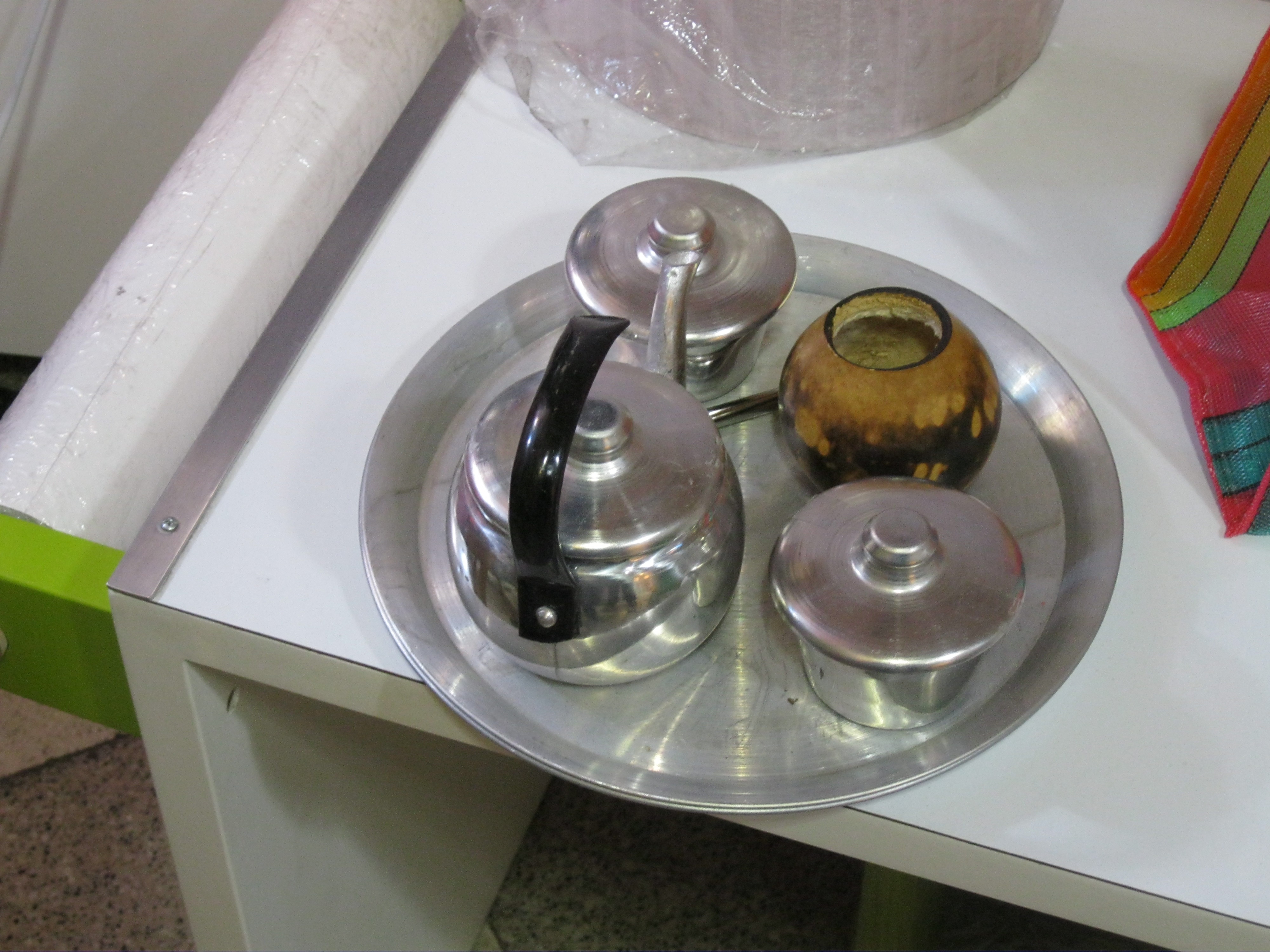
Even toy stores have mate!

Even toy stores have mate!

Somehow we always get picture of food:

20130713-182436.jpg

I did also go to an international conversation night called Mundo Lingo. While it took a lot to get me out of my cozy apartment and into the dark and cold, I ended up having a good time and staying for over three hours nursing my fernet and coca cola. I spoke with a bunch of porteños, primarily in English but with a few sentences in Spanish (maybe more next week), with a Frenchwoman in French, and with a bunch of other interesting people. I got a great tip on a place to go for tango lessons/to observe a milonga, which I think I will check out this week. In the meanwhile, on Friday I bought a pair of jazz shoes so I have something to dance in (that won’t have me twisting my ankle – tango shoes are lovely but generally very high heels). It turns out that my new shoes were made in the little store I was in, and they are leather. Nice little souvenir!

20130713-183830.jpg

Back in BA

On the Friday night I returned to Buenos Aires from Uruguay, I was treated to an impromptu concert in the ferry waiting room after going through immigration. It was a fantastic moment, especially as it distracted me from the group of young men noisily playing soccer in the back half of the waiting room.

I arrived pretty late at the ferry terminal in Buenos Aires, looking for a taxi. There were a bunch of men outside asking travelers whether they needed a radio-taxi, but no standing taxi line. None of the Argentines stopped to get in a cab, so I thought I should follow their lead and went out to the main street. Luckily even late at night it’s possible to find cabs in Buenos Aires, so I made it to the hotel pretty easily. I was staying one night in the Marriott Plaza Hotel (thanks to Marriott points) since I arrived too late to check into an apartment. I don’t know if it’s true, but I’ve read that the Plaza Hotel was the first luxury hotel in South America. It’s located on San Martin Plaza, which meant a lovely view the next morning:

20130709-140043.jpg

20130709-140700.jpg

20130709-141115.jpg

On the Saturday, I checked into an apartment I rented for the first week of July. It was a nice apartment in Palermo, only a couple of blocks from my friend Melissa’s. The only immediately apparent drawback was that it was in an old building…which means old plumbing and thus a request not to flush the toilet paper, but,rather, to throw it away. It’s apparently pretty common in older Argentine buildings, but not my favorite thing.

That night, I had dinner with Melissa and a nice Brazilian grad student. We went for sushi, and I apparently ordered all the wrong things: a tuna roll and something called a fresh roll that sounded intriguing. Well, the tuna was cooked (maybe they can’t get sushi grade tuna here?) and the fresh roll was tasty but weird with salmon, ginger, mango and some weird, slightly sweet noodle as the outer wrapper. Hmm. Melissa’s salmon roll was good, so it might be worth another try!

20130709-143432.jpg

On Sunday, the Brazilian student and I met for some cafe com leche and medialunas, then headed to the Casa Rosada in Plaza del Mayo. Plaza de Mayo is the location where historically citizens have gone to protest. The best known group is that of the Madres de Plaza de Mayo, mothers who protested the disappearances during the dictatorship. On Sunday, I saw big signs protesting that the Malvinas – the Falklands – are, have been, and always will be Argentine. My Brazilian friend told me not to use the word “Falklands” or I’d get into trouble in Argentina. Interesting, since my understanding is that the islanders themselves consider themselves English and don’t want a change in sovereignty.

The Casa Rosada is the location of the presidential offices, and they offer free guided tours on the weekend. We saw a desk and dress that belonged to Evita, got to stand on the famous balcony where presidents and pontiffs and Maradona have stood or celebrated, and even got to enter Cristina Kirchner’s office (only at one end far from the desk). It was a great tour! After, we went to a bookstore in an old theater called Ateneo. It seemed a pricey bookstore, but you can’t beat the building! We wrapped up the day at an organic, vegetarian restaurant called Bio that I will definitely go to again. (Yummy ginger ice cream…)

A Tiny Portuguese Town: Colonia del Sacramento

A week ago Thursday, I traveled from Montevideo to Colonia in the early afternoon, after a lovely walk on La Rambla, the waterside promenade that goes around much of Montevideo’s coastline. On La Rambla, I passed several people walking dogs or out running, enjoying the sun on the water just as I was.

Buying a last minute ticket was very straightforward, and the bus I was on to Colonia was very nice (nicer than the Buquebus as well as much less crowded). There are two companies that run buses every other hour so that there is a bus every hour most of the day.

As we left Montevideo, we passed through the poorest neighborhood I’ve seen in South America (as I’ve definitely been staying in the middle class/white collar neighborhoods so far). There were clusters of one story houses built out of what looked like concrete. Most of them looked to be one or two rooms, some in blocks that were well-maintained and cheerfully painted, others in decrepit clusters. It was a sobering reminder of the masses of people who make do with very little.

I arrived at Colonia’s bus station and found out I only had a few blocks to walk to get to the charming little hotel I had booked. Posada del Angel is decorated in shades of blue and white with a motif of what other than angels? After checking in, I headed to the old town of Colonia, also only a few clocks away from the hotel. (The old town area of Colonia is tiny.)

Colonia was founded by the Portuguese as a base for smuggling into Spanish-held Buenos Aires. The old city is maybe a mile square, if that, illuminating the life of a town from the mid to late eighteenth century. There are still a few intact streets paved in cobblestones with the drainage groove down the middle. There are some old Portuguese (and slightly younger Spanish) houses still intact. While the Spanish houses are white, the Portuguese houses were painted in rich, deep colors. It’s beautiful.

I found a cute little cafe that seemed to cater to locals instead of tourists, and had a slice of cake and a hot chocolate made with milk and melted chocolate. I went to a place on the main square for a pricey and not terribly tasty dinner (starting with a caprese salad where the mozzarella was similar to the hard cheese you can get as sandwich cheese in the States). After, I walked back through completely quiet, dark deserted streets – the old town out of tourist season. The quiet was a little eerie for a city girl!

On Friday, I had the whole day to spend in Colonia, and I had already explored much of it the day before. So I settled in for a lovely, leisurely day, starting with a breakfast of dulce de leche on medialunas (like sweet croissants) and cafe con leche. I then walked around a lot more, going to the city museums which were open. Each museum is in an old house and is one or two rooms of city history exhibits. My favorite was the little red house furnished as an eighteenth century Portuguese house.

I ate a late lunch/early dinner at this little restaurant inside one of these old Portuguese houses on the Street of Sighs (Calle de Sospiros). It’s a wine and cheese/meats/tortas tasting place, and I nursed a surprisingly dry Uruguayan Riesling while enjoying a cheese plate and veggie tortas. It was lovely to sit in the small, low-ceilinged room with its foot-thick walls and wood beams overhead.