Morning Market:


Bucket o’ toads
Eating Lao BBQ and walking to the weaving village across the Mekong (and making one lady’s day by our…ahem…extensive purchases):


Around town:


Morning Market:
Eating Lao BBQ and walking to the weaving village across the Mekong (and making one lady’s day by our…ahem…extensive purchases):
Around town:
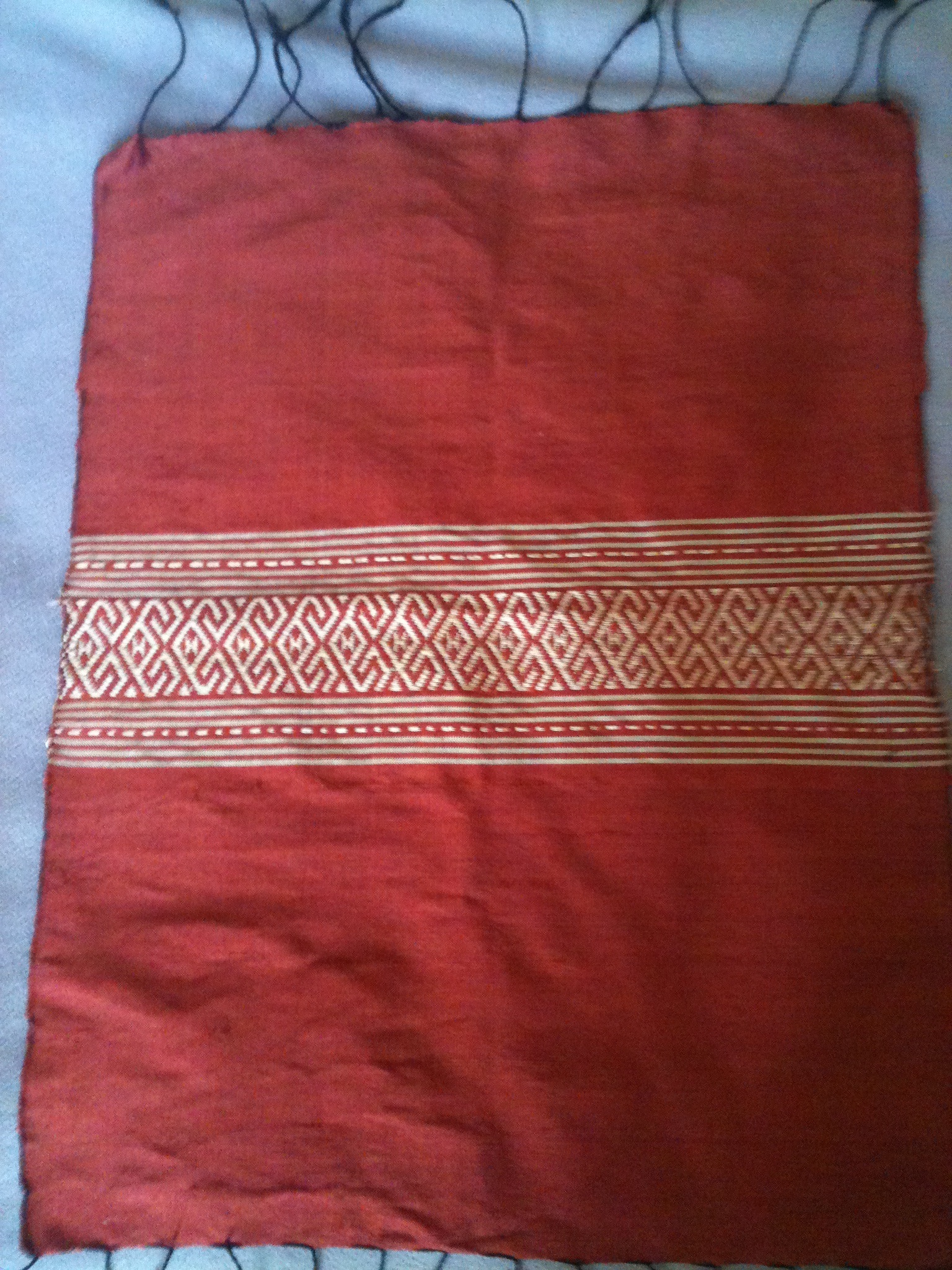
I was super excited to be taking a dyeing and weaving class at Ock Pop Tok (translated as East Meets West). I was taking a one day class, in which I’d learn about natural dyes and weave a silk placemat. Georgina was taking a two day class, so she ended up making a silk scarf.
We headed over to Ock Pop Tok’s handicraft center, where we were greeted with some cups of tea and a beautiful riverside view. It turned out that we were the only people taking classes that day.
First came the dyeing. We heard about the silk production and dyeing processes. I was surprised to see what bright, vibrant colors can be obtained from natural dyes. And it was fun to see chemistry at work – part of the difference between an orange and a red dye, for example, was a rusty nail.
We then walked through the weavers’ section. We learned how the pattern is set up on strings that are set up at the back of the loom. Pulling up a string raises specific threads to run the loom shuttle under, thus creating a pattern. I still don’t understand how they can see the pattern in these threads because they have to know which thread to move up or down at what time. Later on, we found out that each loom may have threads for two different patterns strung on it. Master weavers definitely deserve the title. That walkthrough wasn’t intimidating at all!


We took a break for lunch, and then headed over to the looms that had been set up for us. Each of us had a master weaver to work with, and a translator helped us out as well. I can’t help but feel how boring it must be for them! The translator said it depended on the weaver. An older master weaver liked teaching more, as her eyesight was getting bad for weaving.

“My” master weaver setting up the loom
I volunteered to help clean up the playground for the local preschool that Peter (our guesthouse owner) had helped to found. Georgina and I went over and scrubbed down the slides and merry-go-round, then took a break for the best Lao lunch I’ve had yet, made by Peter’s wife Manichan. It was Lao style, too, which means using sticky rice as cutlery. Then we started work on a sun shade for one of the swing sets. Georgina and I being fairly determined types, we finished putting up the sun shade that afternoon, despite the heat and incredible sun. What a feeling of accomplishment to do something for others and not just for myself on this trip! It took a bit longer than anticipated, so we weren’t able to go to the nearby waterfall as planned. Peter offered to take us along with his kids the following day since it was a school holiday.




We made it to the top and realized that “hike over the top of the falls” was meant quite literally. There wasn’t a path, rather, we waded through pools at the top of the falls and looked down at the view. It was pretty incredible, and I’m proud of myself for having made it that far! We saw some little “fish” at the top that in retrospect I think might have been leeches, but we didn’t bother them and they didn’t bother us.


On the way back, we stopped at Peter’s friends’ place. They are creating a butterfly garden, so we saw some beautiful examples. I can only imagine what it will be like next year, when they are done putting up some of the butterfly attractors.

Then it was a rush to the Royal Palace to be in time to see the Lao Ballet. We saw one part of a story cycle that involved giants, monkeys, and bridge building. (The monkeys were working to build a bridge, but it was disturbing the denizens of the deep. Their princess led them in undoing every night what the monkeys built during the day, until the monkey leader – or his imp, it got a bit lost in translation – worked his wiles on her and she agreed to stop.) Most of the dance was very stylized hand movements. It was very interesting, if perhaps a bit of an acquired taste for westerners (or at least for me).


Georgina and I were ready to head to cooking class! I had chosen to take classes at Tamarind because everyone had raved about how good the food is there, and I had high expectations for the class. I wasn’t disappointed.
We started out with a trip to the market. This was somewhat similar to the Chiang Mai market that I had visited with my cooking class there, but I did still enjoy it. Our charismatic chef-teacher Chai pointed out the various herbs we would be cooking with, along with the live bugs that are a delicacy in Laos. Luckily for our western sensibilities, we wouldn’t be cooking with those!


The layout of the teaching area was quite smart. Tables and chairs bordered the pond for when we were ready to taste the results of our class. Long tables were in the shelter nearby, which was our prep space. Then there was the kitchen area where the clay pots of burning coals were kept, away from the prep area so we didn’t get way too overheated. (My first night in Luang Prabang, trying to find the guesthouse, I had passed a big pile of burning coals and wondered what they were for. Turns out, these clay pots are a common stove in Laos.)


For the eggplant dip, we first roasted the eggplant right in the coals. Garlic and other ingredients were out on kababs and roasted as well. It gave the dip a delightfully smoky flavor that sadly I think I’m going to have difficulty in reproducing at home. 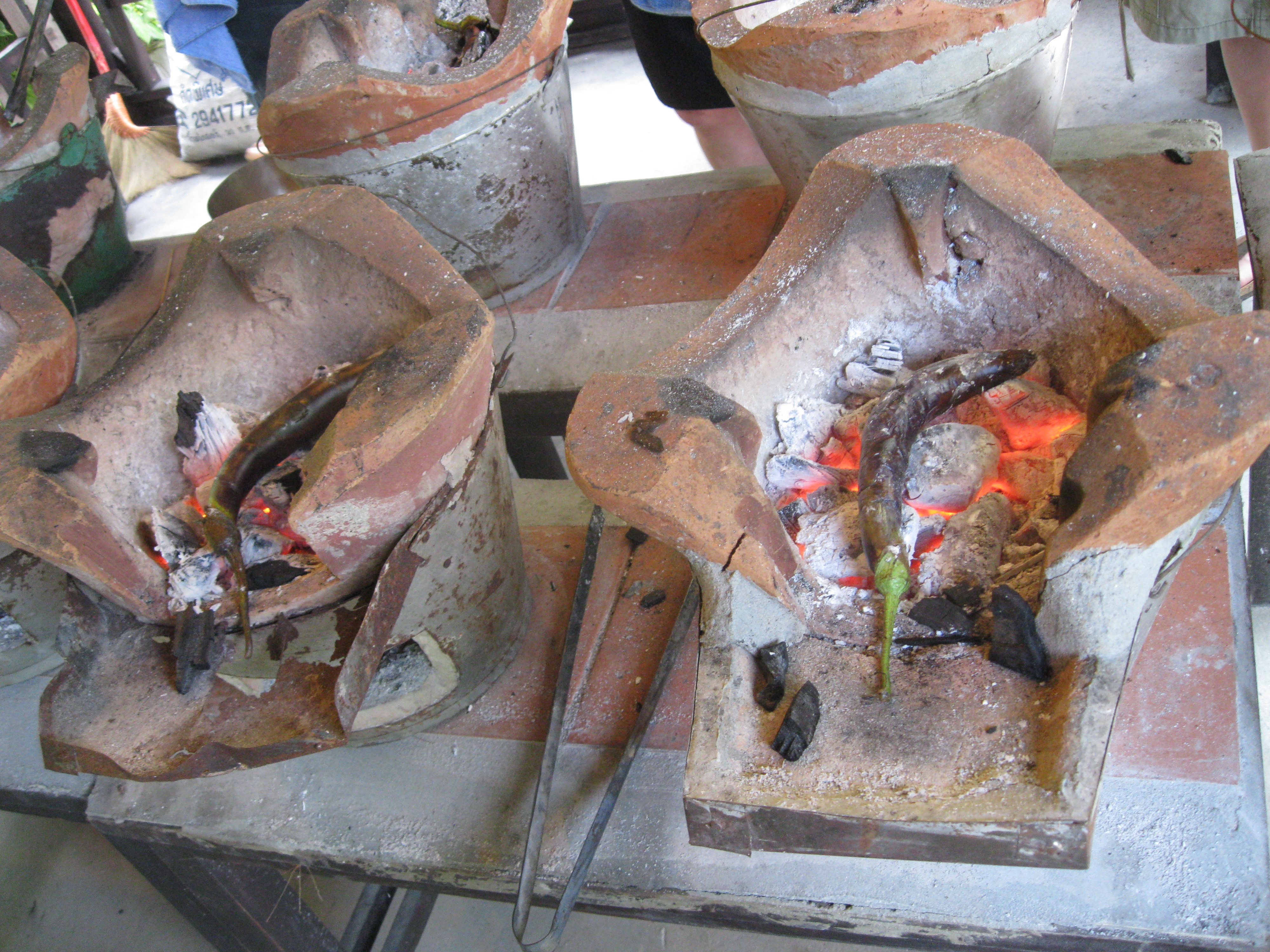 Chai told us that three green chillis and two red chillis would make it “Lao hot”, and Georgina and I both opted to try that. Chai seemed quite surprised when he tasted it, and I have to say that “Lao hot” does mean burn-your-mouth-off hot. (It’s supposed to be even hotter than Thai food!) I wouldn’t make it that spicy again, but boy, it was really tasty!

Mok pa is some kind of white fish (which they kindly filleted for us – Lao would eat the whole fish) marinated in spices and then wrapped in banana leaves to steam. I need to practice making my banana leaf packaging prettier!

The spices are pretty standard for Lao cooking, kaffir lime leaves and lemongrass being two key ingredients.
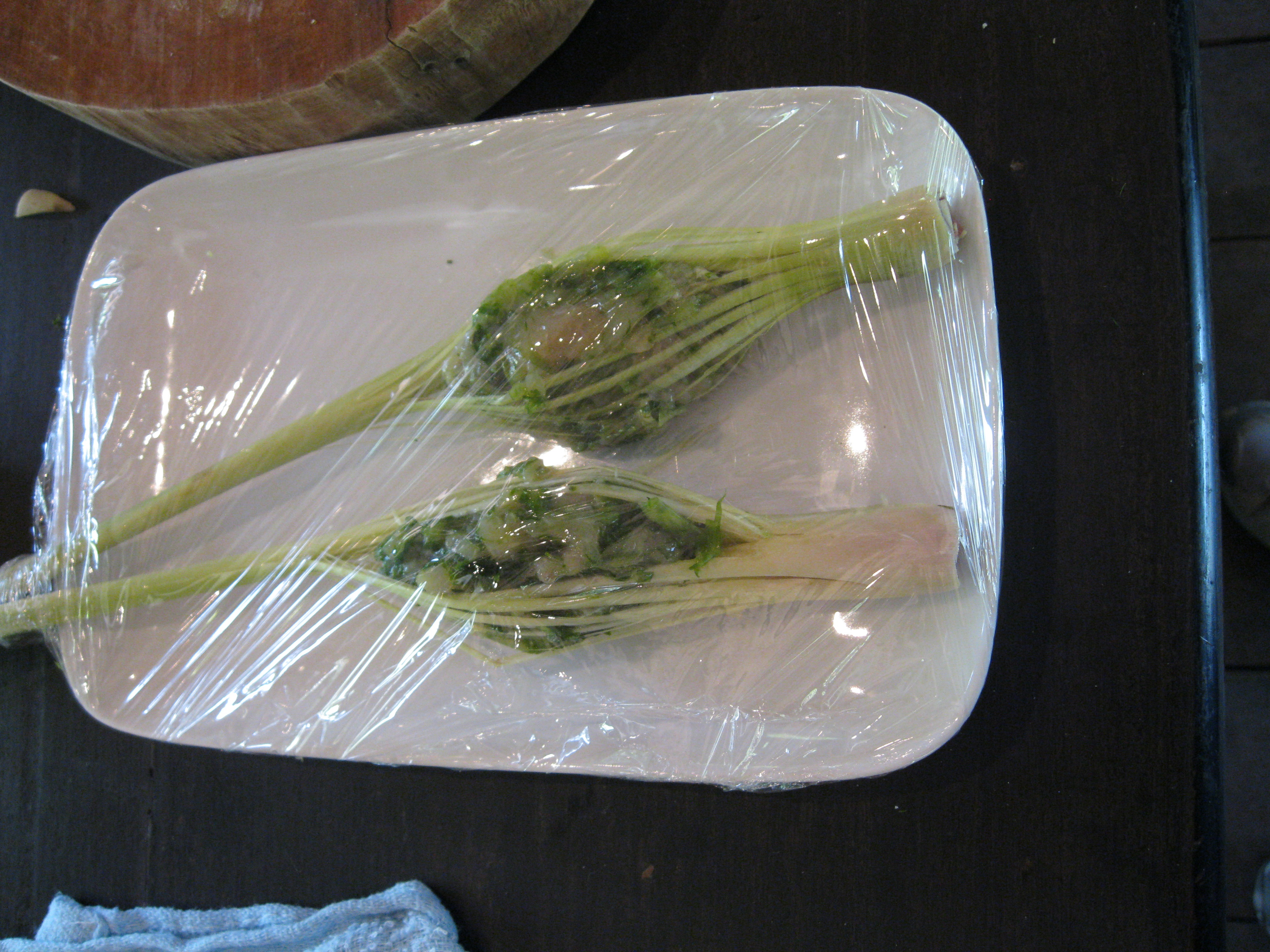
The stuffed lemongrass was another wonder of presentation. If you’ve never cooked with lemongrass, you might not realize it’s a twiggy, slightly woody, very slender plant. Stuffing it is like contemplating stuffing a leek. However, it’s the woodiness that works to its advantage, because you can cut through the stalk multiple times lengthwise and then push the ends of the stalk together so the sliced lemongrass bows outward like a lantern.
This is how it should look:

And this is my attempt:
Finally came the laap, what I’d consider to be the national dish of Laos, and something that Georgina and I were diligently taste testing in almost every Lao restaurant we went to. Chai made his the Lao way – with the buffalo almost raw, beef bile as an ingredient, and tripe in there as well. I have to day, it was really tasty. However, Georgina and I (everyone was partnered since the laap required so many ingredients) were a little hesitant to undercook our meat, and completely vetoed the tripe. Ours turned out pretty well anyway:

Finally it was time for dessert, though we were all terribly full from our multiple dishes. Still, everyone found room for some sticky rice and fruit!
After dessert, we all headed back into town, surprised to find that it was still only mid-afternoon. The choices were food coma or walk off some of the meal, so we were virtuous and chose the latter.
We walked to the National Museum, the former palace in Luang Prabang pre-PDR (People’s Democratic Republic). The main hall has wonderful mirrored mosaics like the wat I had visited the previous day. There was also a room filled with masks used in traditional Lao dance.


Utopia rounded off the day, a fitting stop after the relaxation of a massage.
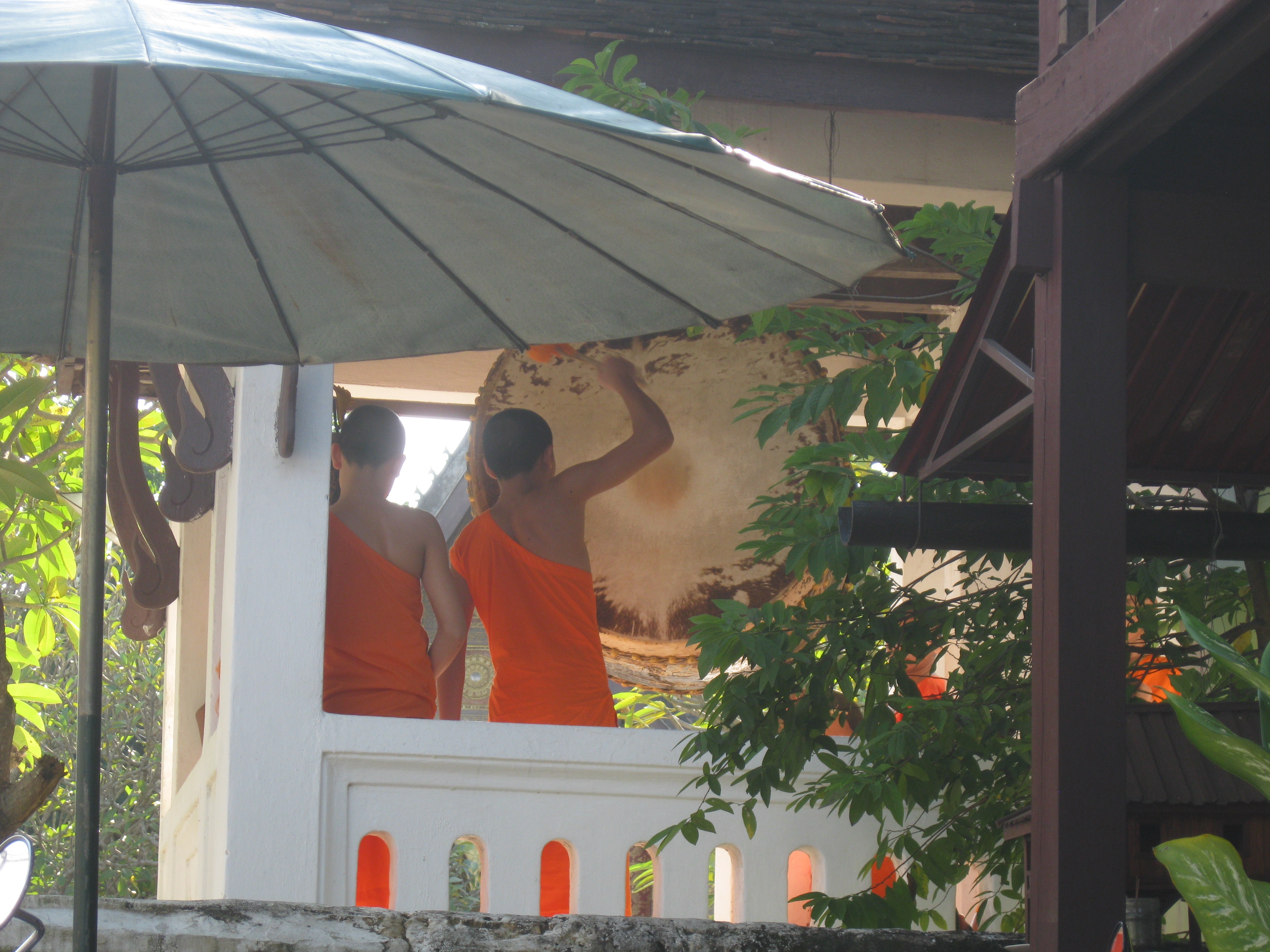
What do mice and monks have to do with one another? English conversation practice at Big Brother Mouse!
Big Brother Mouse is a Lao non-profit that works to bring Lao language books to village children who may never have owned a book before, or even been exposed to anything but a dry textbook. Laos has a big problem with illiteracy, so this is a great non-profit. (For more information, check out their website at:www.bigbrothermouse.com)
Foreigners who want to volunteer are directed to the twice-daily English conversation sessions at Big Brother Mouse. Georgina and I headed over to see whether they needed any volunteers that morning. Speaking good English is key to getting a tourism job, which for many Lao is the path to (relative) prosperity.
We were greeted by a row of six or seven young men turning expectantly towards us. Apparently we were the only volunteers that morning – no pressure! We chatted and translated and explained for two really intense, rewarding hours.
Conversation with people of such a different culture, living under a communist government, can be tricky at times. We needed to steer away from any discussion of religion (though we could ask the two young monks there about their experiences as monks). Proselytizing is illegal and you don’t want anyone to say that your explanation of a term is actually proselytizing. Ditto for politics, of course.
One of the encounters that affected me most deeply was a high school senior who spoke great English and was planning on dropping out of school to get a job. He wanted to know what I would advise him to do, because he deeply respected my opinion as a “falang” or foreigner. (After we spoke, he gave me a very respectful “nob” – the gesture of respect where you put your hands together and raise them in front of your face. The higher your hands are, the more respect you’re showing – and his were almost completely in front of his face.) Foreigners need to remember just how much their actions may influence locals, especially in developing countries.
Then there were the little funny moments of language exchange, like when I tried to explain “jumpy” and one of the guys thought it a synonym of bumpy – as exemplified by Lao roads!
Both Georgina and I were tired out when we came out of our conversation sessions. We walked around a bit and had lunch, after which I popped out briefly to visit an incredible wat she had visited the day before, Xieng Thong. The last two editions of Lonely Planet Laos have had one of its buildings on their covers, the bright pink walls covered in shiny mosaics. I honestly didn’t think the walls in the wat would be pink, but I was wrong!
The main sanctuary building is actually red, but it too is covered in shining colored mirrored glass shards within mosaics. I haven’t seen anything like it in all the was I’ve visited thus far.
There is a little smaller shrine that is pink, also covered in the mosaic work.
The sun was beating down pretty mercilessly, so I headed back to the restaurant. We left around four, and heard drumming coming from each of the wats on “Main Street”. We later found out that it’s a local tradition. Legend has it that giants used to live in the area, preying on the people of Luang Prabang. The monks made a deal with the giants, who would stop eating people as long as they got this drum tribute every day at four.
From the main street we went to a laid-back bar/restaurant/cafe called Utopia. I had heard that it was “the” place to go, so I figured it for a backpackers bar. Not the case, at least if you’re there before eight or nine. Loved it!


The night I arrived at Manichan Guesthouse, I met an Englishwoman named Georgina who was traveling solo and interested in many of the things I was – namely, weaving and cooking classes. The next day at breakfast, I met a woman photographer who ran a non-profit working with hilltribe women who were using cameras to document their lives. There was also a Dutch young woman doing an internship at a fair trade store in the Old Town. A few days later, I met a compatriot named Sadaf who is also a solo traveller (and actually traveled overland from Capetown to Cairo!). Two Belgians, Pierre and Roxanne, were also traveling around the world. This has been the first time in my travels that I’ve stayed at a place where so many people were solo travellers, many on career breaks, most at least in their late twenties or thirties. The atmosphere was fantastic, people sitting around the big wooden table in the courtyard talking over breakfast or after a day out. These were interesting conversations, discussing travel and Laos and wide-ranging topics. The guesthouse owner Peter would join in, often over a game of Uno with him and his son. In fact, it became the kind of experience that the books and blogs say solo travel is about – traveling solo so you can meet new people and do things with them. An adorable fur ball puppy just rounded out how ridiculously wonderful my stay was.
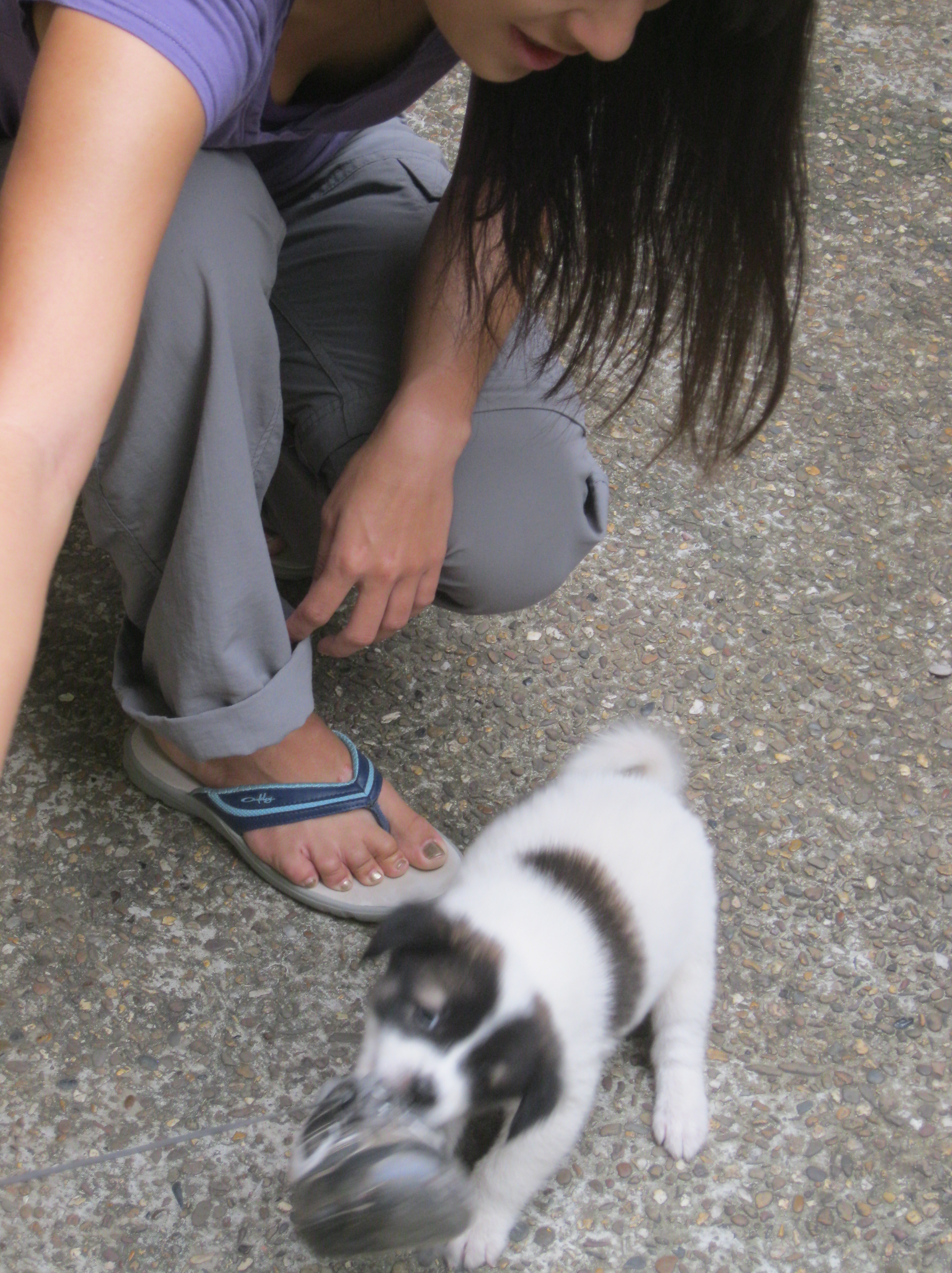
Georgina and Jacques
As part of this, my first morning in Luang Prabang was spent in part in changing my scheduled classes so I could do them at the same time as Georgina. I was very excited to be taking both a cooking and a weaving class, and we thought it would be fun to have company. My plan is to take a cooking class in each country, so I can better compare the cuisines.
I also got to meet up with an old college friend who currently lives in Cambodia but was in town for the first ever Luang Prabang half marathon that weekend. (What are the odds? Apparently pretty high since Georgina also knew someone running the race!)

Saturday’s half marathon


The shop at TAEC also has some amazing examples of textiles, not as cheap as buying it directly from the craftspeople, of course. I bought myself a reversible cap since packing away my wide-brimmed straw hat hadn’t done it any favors. (I was also planning on being around people more in Luang Prabang than I had been elsewhere, and wanted something at least a nod closer to fashionable!)
I ate lunch and blogged at Le Patio, the cafe attached to TAEC, in an effort to avoid the blazing sun. They use some of their textiles as table runners, which I enjoyed idly admiring as I sipped my (almost toothpaste-tasting) mint syrup and bubbly water concoction.
I managed to see a lot of the Old Town without going out in the worst of the sun too much, always a plus!
On the last day of September, I hopped on the Green line bus to Chiang Kong, wending my way through northern Thailand. We went up and down lush hills, continually heading onto higher ground. I saw a lot of what looked like marijuana growing in fields by the side of the road, but I’m guessing it was a different plant as the Thais have fairly aggressively worked with the northern farmers to eliminate drug farms. Even if those farmers are growing the drug, I doubt that they would do so right by a national road!
The trip was bumpy, but not quite as nausea-inducing as the trip to Chiang Mai. They served us water and cookies, and even showed a movie (what I think was one of the Fast and the Furious franchise, dubbed into Thai. That was confusing, I mean, interesting).
I had read enough blogs to know what to expect when we reached Chiang Kong, namely no bus station and a horde of tuk tuks waiting to take us to Immigration. As the price stated was less than what other bloggers had paid, I was happy to hop on a tuk tuk and we puttered over the few kilometers to Thai Immigration. There was a sign nearby saying “information” and “visa help” but I decided to bypass it (with some trepidation) and go straight to Immigration hoping I wasn’t missing any steps. Exiting Thailand was a breeze, and I went downhill to the boats to cross the Mekong into Laos.

Crossing to Laos

First view of the Mekong
The Lao visa on arrival line wasn’t long, though it took them a little while to paste the visa in. I ran into two of the guys with whom I’d travelled from Phitsanulok to Sukhothai – the joys of traveling a common backpacker route!
Then up the street and to the left, to check the rooms at the B.A.P. Guesthouse. They looked ok, so I took a room despite it being the first guesthouse I looked at. And I saw several people head out to comparison shop and then end up back at B.A.P., so that was a good sign. I also decided to get my slow boat ticket via the guesthouse, after walking down to the quay, as they arrange for the tuk tuk down. The lack of hassle was worth the mark-up.
Then my first beer Lao with dinner (because it’s Laos, of course) and off to bed in good time.
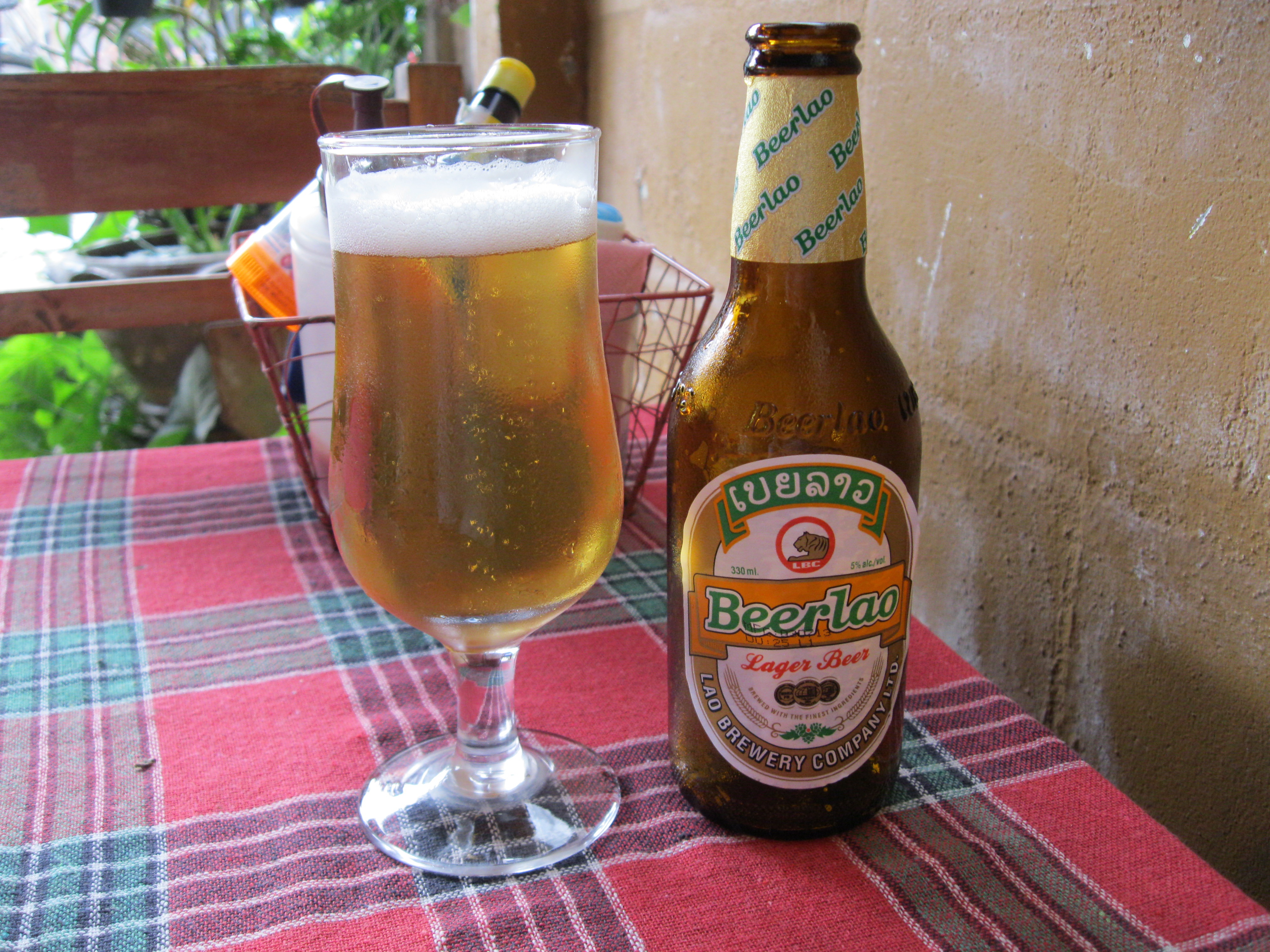
The next morning, I hopped on the tuk tuk with a couple of guys also heading to the slow boat. We arrived perhaps an hour early, but since there isn’t really anything to do on the pier, I decided to board early. Luckily, I was pretty much the first person on, since it meant I got my assigned seat and nobody but the crew was there to witness my difficulties in boarding the boat over the narrow plank. (Big backpack, bad balance, enough said.) The bag went into a hole where they had lifted up one of the deck planks, so everyone boarding had to shimmy around the edge.


The trip down the Mekong takes two days. Most of the time is spent looking at scenery, reading, or talking to your neighbors. I was pretty happy just looking at scenery for most of the first day. Most of it was beautiful, tree-lined hills in between the rare village probably only accessible by river, although I did see a dead pig float by and there were yellowish sponge-like things that someone said were soap suds. Pristine water it is not.


If I had thought boarding was hard, getting off was worse, with the plank off the ship being half the width and tilted at a steep angle. But once again I managed not to fall in, so anticipation was no doubt worse than execution.
I bypassed the guesthouse touts and headed to a guesthouse reviewed by Lonely Planet. When I agreed to take a room, I was asked whether I’d be willing to share with a Chinese woman about my age. Turns out that she was traveling with her brother and sister, and I guess the guesthouse only had two twin bed rooms (though I didn’t see anyone else there). I was taken aback since I’d expected my own room, but agreed since she was part of a family party and seemed nice enough. And you can’t beat the price of five dollars per person for the room! I actually ended up having dinner with her and her siblings, which was nice.
Laos has a curfew, so we all headed to bed early in preparation for the next day.


Shortly before we arrived in Luang Prabang, we passed Pak Ou caves on one side (caves where bunches of Buddhas were collected) and this huge, dramatic karst formation on the other side, where another river joined the Mekong.


On Sunday morning, I headed out to the bus station to get my tickets for Chiang Kong. Since a songthaew driver wouldn’t take me (probably because it was too far off his route), I negotiated a ride with a tuk-tuk driver for 80 baht, down from 100. He agreed with such alacrity that I suspect I still overpaid, but hey! I’m learning this bargaining game!
Heading back, I checked out the songthaew line, but they quoted me a price of 150 bahts for me to take a non-shared ride. Obviously I wasn’t going to spend that, so I waited until they had a full load of people and felt almost like a native in my foreigner-free songthaew.
I headed back into town to look at one more beautiful Wat that I had missed, then wrapped up the day by walking through the Sunday Walking Street. I did a little bit of shopping, had a fresh fruit juice in a bamboo “cup”, and got to take a picture of some of the more interesting food (bugs).
Next stop, Laos!
Wat viewing:


Walking street:


On Saturday, I decided that I was going to visit the Wat at Doi Suthep, perched on one of the hills above Chiang Mai, despite the clouds that wisped over the hill.
I grabbed a songthaew to Chiang Mai University/the zoo, where there was a songthaew line to go up to Doi Suthep. When we had ten people, the cost was forty bahts per person. On the way up, I started chatting with a Frenchwoman who turns out to be a math prof. (Tough arena to be a woman in, so props to her!) We decided to travel together during the day’s explorations.
First came the 306 steps up to the temple complex, lined with little touristy booths. Climbing that many steps in the humidity made me realize that despite all the walking and climbing I’ve been doing, I still need to get in better shape! Ah well, the killer humidity is my excuse, right?!
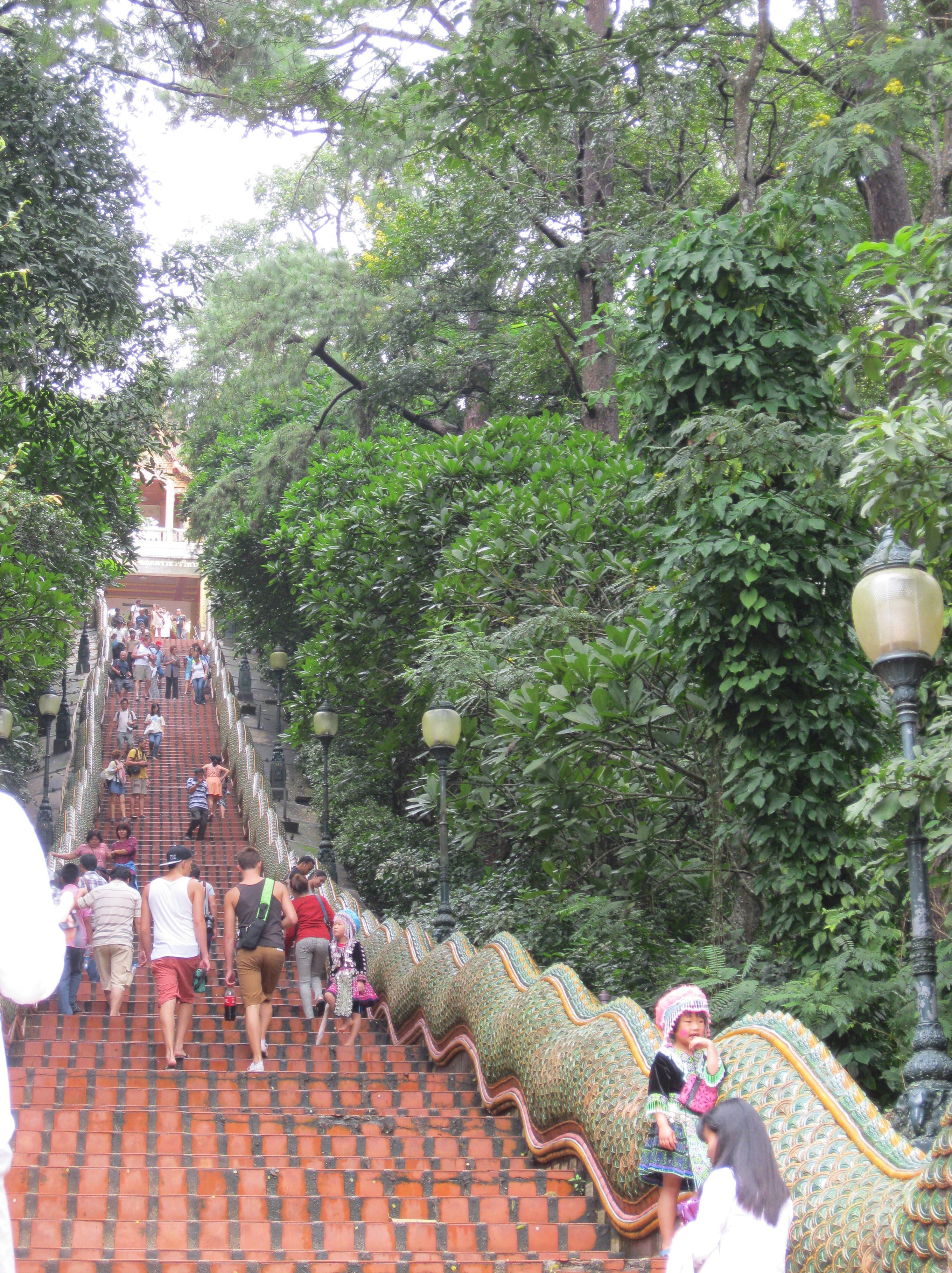
The 306 stairs to Wat Doi Suthep
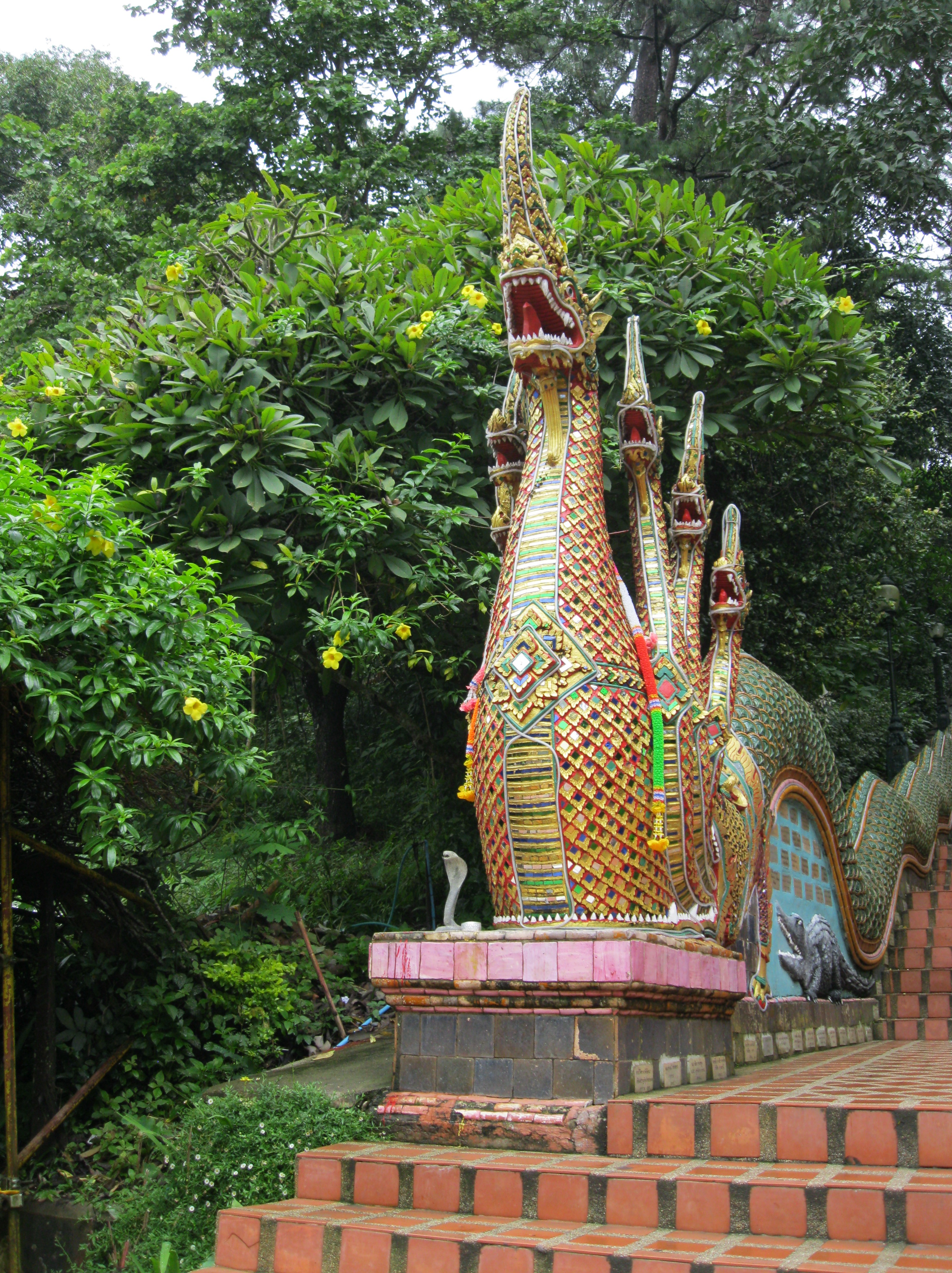
A naga guards the stairs up to Doi Suthep
The Wat really is magnificent, with a big golden chedi at its center. There were a ton of tourists and I felt a bit bad for contributing to the camera-clicking hordes, as people went for legitimate religious purposes, getting blessed by the monks. (I know people who aren’t Buddhist who do that on their visit. While the blessing from a monk would have been cool – despite our differences in religion – the appropriate respect/bowing/kneeling didn’t make me comfortable as a non-Buddhist, so I decided to pass.)
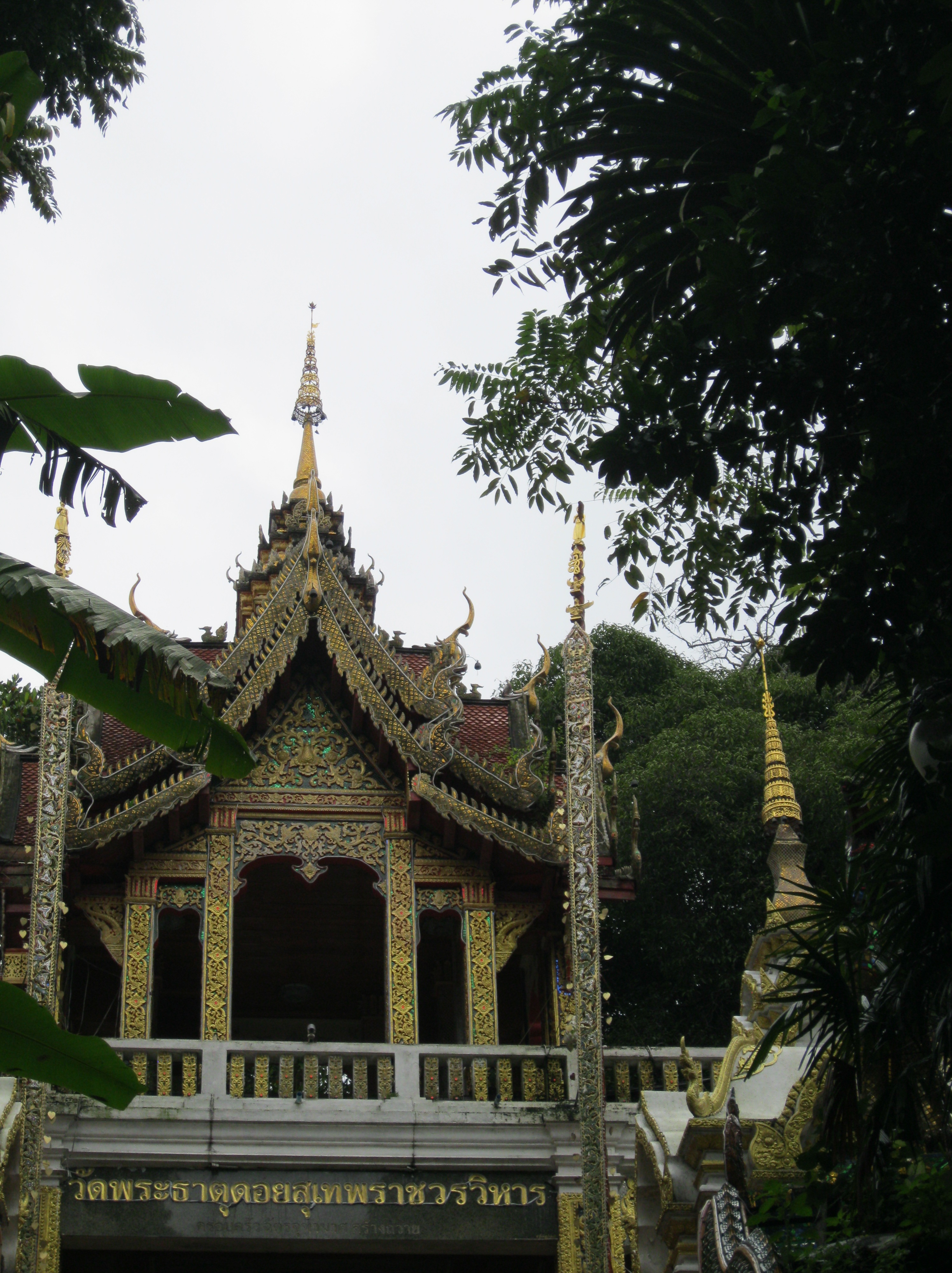
First view of the Doi Suthep complex

Golden Chedi Doi Suthep


After the Wat, I decided to head to the Hmong village further up the mountain. I’d heard it was very touristy and commercial but still a decent place to look at Hmong handicrafts. As we popped into a songthaew, the skies opened in a typical wet season deluge. We were happy to be dry!
We headed up in our rattling vehicle (which may have been an unofficial songthaew as it wasn’t bright red and was a different make of truck) and dropped off the two other passengers at the palace. They had a very difficult time with the driver telling him not to wait or return for them since they didn’t know how long they would be.
Off we went again, only to stop shortly after one of the curves on the road in the middle of nowhere. The French prof and I looked at each other in dismay as we realized that we were completely dependent on our driver. The driver yelled “toilet” at us and disappeared for a few minutes. Weird and uncomfortable in the middle of a deserted road where another Thai driver could easily rear end us, but in the end no harm done. We continued and were delivered to the village. We didn’t bother on the extended explanations of not to wait for us after the other passengers’ experience, just paid and headed to the village.
The village seems to be divided into two parts, the upper looking like it was where people actually lived, the lower part being a long, straggling loop lined by shops.

The Hmong village

The purse I bought held by the Hmong lady who made it
All this time, we saw the driver circling through the village, waiting for us. I’m sure it was harmless, but being followed didn’t give us a great feeling and we decided to take a different songthaew down. Unfortunately we weren’t able to communicate this well, which I do feel bad about, as I have a feeling we came off more as privileged and spoiled westerners when the reality was that we were two women in an uncomfortable situation.
We popped in briefly to the little dark museum, getting trapped long enough by another violent rain shower that our eyes adjusted and let us read the posters there. The museum is near a sign for a “demonstration field” of opium poppies which we decided to pass on. We then had lunch in a local noodle shop and headed to our drop-off point.


Sadly, the multitude of red songthaews we had seen earlier had disappeared and there was just one minus a driver. We asked where the driver was and a cafe owner started to look for him. Then the songthaew tout said a spate of Thai that probably meant we were not to be helped since we’d refused going with the other driver. The songthaew mafia was closing ranks, and I had a bad feeling we might get stranded.
Luckily, a tour group was leaving just around then and I honed in on the one tourist who looked like an English-speaker. I explained to him that we had no other way down the mountain and could he ask whether the tour group could take us down to anyplace where we could get another songthaew. To my amazement and relief, he did, and the tour guide acquiesced! We were saved by the kindness of strangers! It was a wonderful feeling to feel safe again, even if the worst that would probably have happened to us would likely have been some “kind Samaritan” charging us five times the going rate for a lift in his car.
I still wish I knew how to have handled the original situation with more grace, but I’m honestly not sure what we could have done. If anyone has any suggestions, please let me know!
To wrap up the day, we went to the Saturday night “walking street”, one of the weekly markets that are an institution in Chiang Mai. We had been hoping to see a lot of artisanal handicrafts, but on the whole were more impressed with the Hmong village. It was a lot of fun, though, and I tried a random sampling of street food. We saw a couple of rhinoceros beetles (fantastic!), which I think the locals catch to have fight each other (not so fantastic). We saw a stall selling various cooked bugs, considered a delicacy. And lots and lots of “elephant pants”, harem style cotton pants that all the tourists buy (and that I admit I got a pair of since I needed to do laundry!)

Rhinoceros Beetle at Chiang Mai’s Saturday Walking Street

Rhinoceros Beetle Close-Up
Friday was one of the most enjoyable days in my travels – cooking class! I’d decided to go with Thai Farm Cooking School since my Lonely Planet guidebook mentioned that class was actually on the farm outside of the city, and the website was good. They didn’t disappoint!
I was picked up in their song-theow and met the other participants: three folks from the US, a lady from Hong Kong, and two young Dutch women. Personalities meshed pretty well, especially when adding our charming young teacher to the mix.
We started out at the market where we learned about the difference between coconut milk and coconut cream, jasmine rice and sticky rice. Then out to the farm where we got to see the plants we would be using. Who knew that turmeric was a root that is shaped a bit like ginger but is – surprise – yellow inside.
First up was making curry paste – easily the most difficult part of the day since you need to use a mortar and pestle. I don’t think I minced my ingredients finely enough, or I’m a weakling when it comes to blending in by hand!
After the chili paste was ready, we moved on to Tom Yum soup and chicken with hot basil so we could eat something.


The afternoon continued with the green curry and pad thai, wrapping up with mango and sticky rice. (I should note that everyone got to choose what fish they made per “course” and I’ve just listed what I picked. Others chose red curry, for example, for the curry course.)


 trails untrod